Britain’s transition to electric vehicles must be urgently reviewed to reflect changing economic and global realities, according to new analysis from the automotive industry.
The Society of Motor Manufacturers and Traders has warned that the pathway towards zero emission vehicles was built on assumptions that no longer reflect current market conditions.
The industry body says rising battery costs, higher energy prices and slower consumer demand mean the transition risks falling behind government targets.
Its latest report argues that without a reassessment of policy, both the UK’s net zero ambitions and economic growth could be put at risk.
Despite strong investment from manufacturers and a growing range of electric vehicles available to drivers, the market is still struggling to meet official targets.
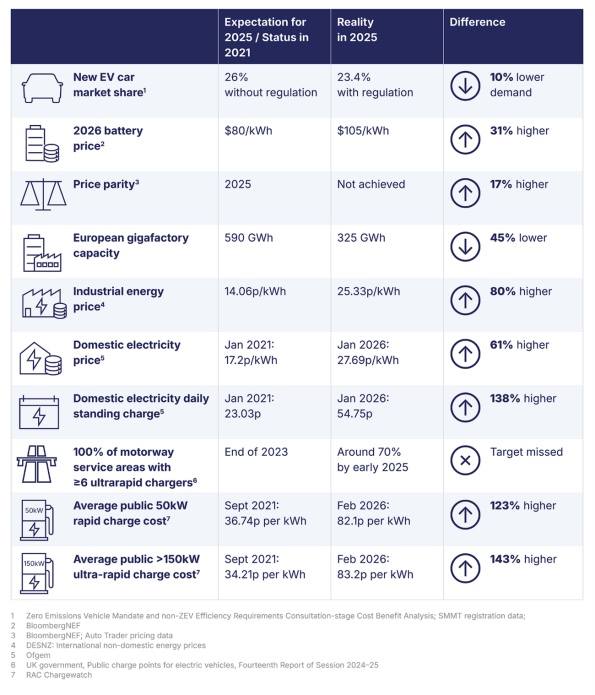
In 2025, battery electric vehicles accounted for 23.4 percent of new car registrations in the United Kingdom.
That figure falls short of the 28 percent required under the government’s zero emission vehicle mandate and below the 26 percent previously expected without regulation.
The industry says manufacturers have been bridging the gap between policy targets and real world demand through heavy discounting.
More than £10 billion has been spent on incentives over the past two years to encourage buyers to switch to electric vehicles.
However, the sector warns this level of financial support cannot be sustained.
From 2027 the targets become significantly tougher, requiring zero emission vehicles to account for 52 percent of new car sales and 46 percent of new van sales.
The report says natural consumer demand is unlikely to rise quickly enough to meet those levels.
Global economic changes have also reshaped the cost of electric vehicle production.
Battery costs are estimated to be more than 30 percent higher than expected, while industrial energy prices have risen sharply.
Since 2021 energy costs have increased by around 80 percent in the United Kingdom and 28 percent across the European Union.
As a result, the anticipated price parity between electric vehicles and petrol or diesel models has not yet been reached.
Charging infrastructure has expanded in recent years, but the cost of public charging has also increased in some cases by more than 140 percent over the past five years.
Targets for rapid charging facilities have also fallen behind schedule, with only around 70 percent of motorway service areas meeting the goal of installing at least six ultra rapid chargepoints by early 2025.
The challenge is particularly significant for commercial vehicles.
Zero emission vans made up just 9.6 percent of new registrations in 2025, well below the 16 percent required by regulation.
Adoption of electric heavy goods vehicles remains at an early stage, accounting for only 1.4 percent of the market.
Mike Hawes, Chief Executive of the Society of Motor Manufacturers and Traders, said the industry remains committed to net zero but believes the transition plan must reflect changing conditions.
“The UK’s EV transition pathway was conceived with the best of intentions but the assumptions behind it have proved over ambitious.
“A landscape which once looked solid has turned out to be quicksand.
“Recognising the world of 2026 is not the one envisaged five years ago is not a retreat from ambition.
“It is a necessary step to achieving it.
“We need an urgent review that reflects today’s realities, that delivers decarbonisation not deindustrialisation and offers consumers the choice they have always expected.”
The industry is now calling on the UK Government to conduct a strategic review of the transition to zero emission vehicles to ensure climate goals can still be met while protecting economic growth and investment.