Highland Council is facing growing calls to use money raised from its proposed Visitor Levy to tackle the region’s housing shortage, with campaigners demanding that a quarter of the revenue be invested in social housing.
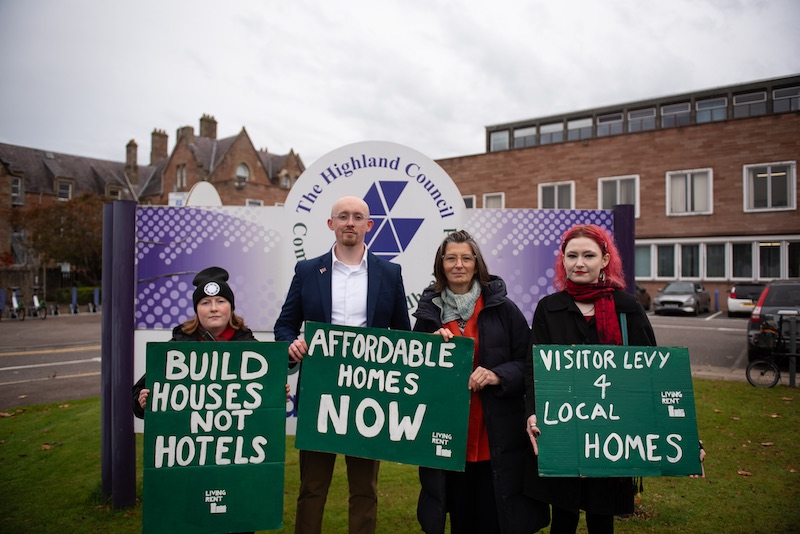
Scottish Green MSPs Ariane Burgess and Kristopher Leask joined residents and members of tenants’ union Living Rent outside Highland Council headquarters in Inverness to support the proposal ahead of a council decision scheduled for 10 December.
Living Rent wants 25% of the estimated £9 million annual revenue reserved for housing, alongside a commitment to collect the levy throughout the year.
Under the council’s current proposals, visitors would pay £5 per room per night in hotels, guest houses and short term accommodation, with a reduced £2 charge for hostels, campsites and caravan parks.
The proposed spending arrangements would allocate 50% to visitor infrastructure, 20% to culture and events, 15% to community projects and 15% to business and skills.
There is currently no specific allocation for housing, while the levy would not operate during December, January and February.
Campaigners argue that the people working in Highland tourism are increasingly struggling to find affordable homes in the communities where they are employed.
At the end of March 2026, there were 8,767 applications on the Highland Housing Register, highlighting the scale of demand for housing across the region.
The Greens have pointed to Edinburgh, where £5 million annually from the city’s Visitor Levy has been committed towards housing.
Ariane Burgess, Scottish Green MSP for the Highlands and Islands, said:
“The Highlands welcomes millions of visitors every year, and we’re proud to.
“But the people who make that possible, who clean the rooms, cook the food, run the tours, they are faced with spiralling rents and are being priced out of the communities they keep going.
“Edinburgh is already collecting its levy and putting £5 million a year into affordable homes.
“In the Highlands, the draft scheme doesn’t guarantee a single pound for housing.
“I believe that is a huge mistake.
“The Scottish Parliament declared a national housing emergency in May 2024, and our communities deserve an emergency response.
“Social housing provides tenants with the foundation for a stable life.
“Increasing rents in the region, and the loss of homes to short-term lets have had a huge impact on local people.
“I welcome Living Rent’s demands and want to see Highland Council deliver them in full if they are serious about tackling our housing crisis.”
Kristopher Leask, Scottish Green MSP for the Highlands and Islands, said:
“Scottish Greens fought to give councils the power to introduce a visitor levy, and Highland Council now has the chance to use it properly.
“Where local people are the ones impacted by tourism, it should be local people who have a say in how the visitor levy is applied and spent.
“A levy that switches off for a quarter of the year and leaves housing out of the spending plan is a missed opportunity.
“Visitors come in winter too, and every community I speak to across the region says the same thing: we desperately need homes people can afford to live in.
“Highland councillors should take heed of the calls from local residents, and ensure any money collected is spent where it is needed most, on building genuinely affordable and secure social housing”
Chris Ballance, Scottish Greens councillor for Aird and Loch Ness, said:
“Green councillors have consistently called and voted for money to be ring-fenced for social housing.
“Nearly 9,000 applications are waiting on the Highland Housing Register, and behind each one is a resident or a family that can’t find a secure, affordable home.
“This simply isn’t good enough.
“As a Council, we should be using every tool at our disposal to address the housing crisis.
“We will continue to push for a year-round levy with money ringfenced for social housing.”
Living Rent member and local resident Watson said:
“A visitor levy can be used for the benefit of the local community and visitors alike, with the ever-increasing tourism in the Highlands that we are experiencing, we need to invest back into our communities and help people settle and live in the Highlands.
“We cannot have unrestricted growth of tourist and continue to live with the negative impacts this has on local communities.
“Tourism impacts us all so local people need to benefit from it, not just businesses.
“Every time I travel, I am happy to pay a visitor levy and invest in the communities I visit, many visitors to the highlands will be the same”
Living Rent Community Organiser Louis McIntosh said:
“The Highlands is in the midst of a housing crisis and our public services are crumbling.
“The Council needs to introduce a visitor levy and raise much needed funds now.
“Right now, across the Highlands, residents are being forced out of their communities due to a lack of homes and expensive rents.
“This levy has the power to raise funds that could be spent on delivering social housing.
“Our communities sustain tourism by working in hospitality, culture and local businesses, but we cannot keep this up if we do not have affordable homes to live in.
For too long, residents in the Highlands have felt that their demands for improvements in their communities have been ignored.
“The Highland Council needs to stop delaying and introduce a visitor levy with money ringfenced for social housing now.”
The demands come as businesses across the Highlands are also questioning the proposed levy, with concerns about its potential impact on visitor spending and the wider tourism economy.
Any allocation towards housing would need to comply with the legislation governing how Visitor Levy revenue can be spent.
Highland Council’s consultation closes on 30 November, with councillors scheduled to consider the proposals on 10 December.
Even if approved, the scheme would require an 18 month lead in period before charges could begin.
With thousands of households seeking affordable accommodation and businesses examining the costs of the proposed levy, the question of how the money would be spent is becoming central to the debate.