

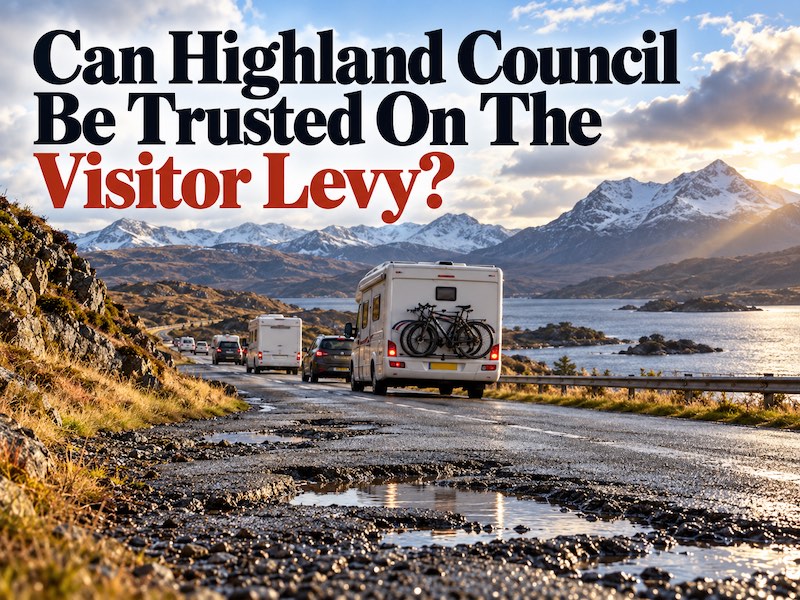
The Highlands need better roads, reliable public services and infrastructure capable of supporting millions of visitors, but as Highland Council prepares to introduce a potential £9 million annual Visitor Levy, a more uncomfortable question is emerging about whether the authority can command the public’s trust.
With councillors due to decide in December whether to proceed, concerns about the proposed charge are becoming entangled with wider questions about the council’s record on transparency, accountability and decision making.
The case for additional investment is substantial, with almost 39% of Highland Council’s road network requiring maintenance and a capital repair backlog estimated at £233 million.
Tourism contributes enormously to the Highland economy, but accommodating millions of visitors also places demands on roads, public conveniences, parking areas and other facilities which somebody must pay to maintain.
That principle deserves serious consideration, regardless of political differences over how the money should be raised.
Yet supporting the principle of a Visitor Levy does not automatically mean accepting every aspect of Highland Council’s proposed scheme.
The council estimates that its levy could generate approximately £9 million annually, with accommodation charges ranging from £2 to £5 per room or accommodation area per night.
However, one of the most contentious features is that motorhomes and campervans staying outside formal campsites would not be subject to the charge.
A visitor staying in a Highland hotel would pay, while someone spending the night in a campervan at an informal location would escape the levy altogether.
Motorhomes using formal campsites would be covered, but those staying elsewhere fall outside the scope of the national legislation, a distinction Highland Council itself has previously challenged.
The question of fairness becomes still more complicated when Highland residents staying overnight elsewhere within their own council area could also be required to pay.
There are equally important questions about where the money would go.
The council proposes indicative allocations covering visitor infrastructure, community projects, culture, events and business development, with an advisory Visitor Levy Forum helping shape priorities.
But final decisions on spending would remain with Highland Council.
That brings the authority’s wider record into consideration.
At Milton of Leys in Inverness, residents have spent years seeking answers about amenity land maintenance obligations established through planning arrangements dating back to 1999.
Highland Council recently fully upheld a complaint concerning its failure to provide substantive answers, while acknowledging that the original planning agreement remains in place and some later maintenance conditions require further examination.
Then there was the taxi licensing controversy, when councillors voted to take no action against licences held by a man convicted of raping a young passenger, despite police objections.
The decision was subsequently condemned within the council itself, and five councillors faced an overwhelming vote of no confidence.
Separately, a Freedom of Information request concerning one of those councillors has been refused as vexatious, with the applicant seeking a formal review of that decision.
A lawful refusal does not establish concealment, just as the other controversies do not demonstrate that Visitor Levy funds would be mishandled.
Nevertheless, each raises legitimate questions about how public bodies respond when their decisions are challenged.
Highland Council has proposed statutory reporting arrangements, public consultation and a representative advisory forum, all of which provide opportunities for oversight.
The issue is whether those safeguards will be accompanied by detailed public accounts, independently scrutinised spending and clear evidence that money raised represents additional investment rather than replacing existing funding.
The council’s consultation closes on 30 November, with a decision scheduled for 10 December.
Before that decision, residents and businesses deserve to know exactly how the money would be controlled, what independent scrutiny would apply and how communities could hold decision makers accountable.
Highland Council is asking the public to support a potentially valuable new source of investment.
The public is entitled to ask what the council will do to earn that confidence.
Because the question is no longer simply whether the Highlands need the money.
It is whether Highland Council can demonstrate that it deserves the trust being placed in it.


