

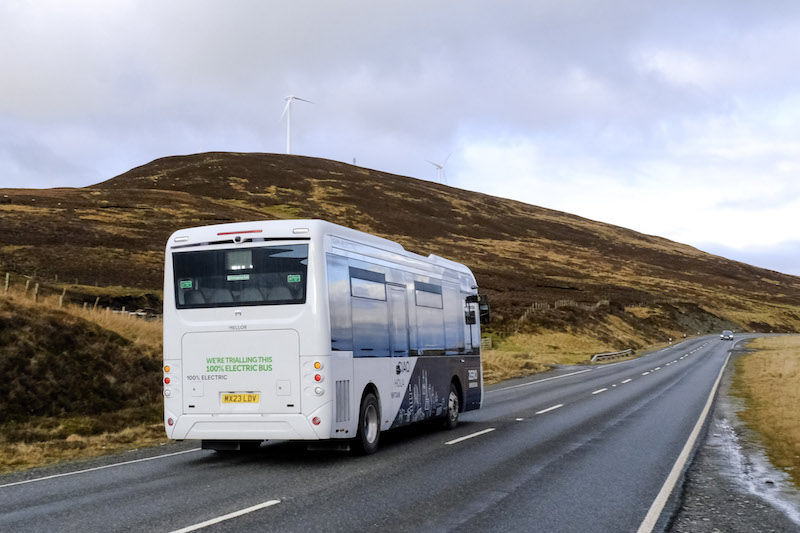

Shetland Islands Council has published the findings of its first electric bus trial, concluding that the technology can operate on Shetland’s roads while also exposing significant challenges that must be addressed before any wider rollout.
The trial ran from February to June and saw a 27 seater Sigma electric bus operate on routes across mainland Shetland to test performance in local conditions.
Funded entirely by Innovate UK at a cost of £120,000, the project set out to examine how electric buses cope with Shetland’s climate, topography and road network rather than relying on mainland assumptions.
Although the vehicle was not used for public services, it was driven on live routes with frequent stopping, simulated passenger loads and normal operational patterns to mirror day to day use.
Local bus operators were given the opportunity to drive the bus and provide feedback, allowing practical experience to inform the assessment.
Independent analysis by consultants Exceliamus found that electric bus operation is feasible in Shetland, but only with careful planning and significant supporting investment.
The report identifies high upfront vehicle costs, limited electricity grid capacity for charging and space constraints at existing depots as major barriers to immediate adoption.
During the trial the bus achieved an average range of around 100 miles on a full charge, with performance and reliability comparable to a diesel vehicle under the conditions experienced.
However, the trial period did not include Shetland’s coldest weather, and the report warns that colder temperatures combined with increased use of heating and wipers are likely to reduce efficiency and range.
As a result, the report recommends a further trial during colder conditions using a larger vehicle, alongside testing buses fitted with heat pump systems to improve winter energy efficiency.
The findings conclude that a full transition to electric buses cannot realistically be delivered during the 2026 to 2031 bus contract period.
Instead, that timeframe should be used to build a detailed business case, assess charging infrastructure needs and gather further operational evidence tailored to island conditions.
Moraig Lyall, Chair of the Council’s Environment and Transport Committee and ZetTrans, said:
“This project has given us some real evidence about how an electric bus performs in Shetland’s climate and terrain.
“It shows both the promise of new technology and the practical steps still needed to make it work at scale.
“ZetTrans will use the learning from this trial to inform a new Public and School Transport Decarbonisation Plan, which forms part of the forthcoming Regional Transport Strategy Delivery Plan 2026 to 28.
“The aim is to make progress toward cleaner transport in a way that’s affordable, reliable and right for Shetland’s communities.”
The Council says the trial provides a grounded starting point for future decisions, ensuring any move toward lower emission public transport reflects Shetland’s realities rather than a one size fits all approach.


