

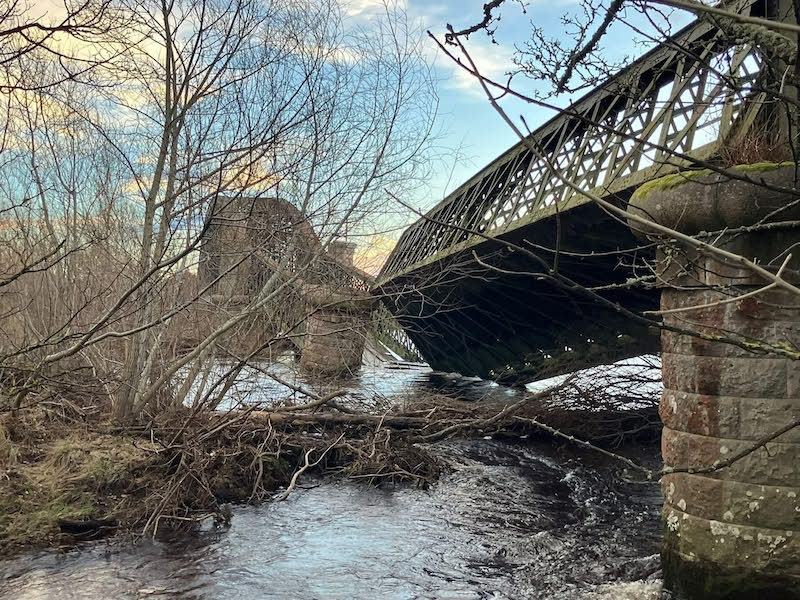
Moray Council has confirmed that a partial collapse of the Garmouth Viaduct over the River Spey was most likely caused by scour, following an initial engineering assessment of the structure.
The update comes after council engineers inspected the viaduct and concluded that fast moving water appears to have eroded material around the bridge’s foundations after a change in the river’s flow path over the past year.
Moray Council said there was no evidence of scour at the time of the last specialist assessment carried out in 2023, and that the river’s behaviour has since altered in a way that may have increased pressure on the bridge piers.
A more detailed inspection by a specialist engineer is now being arranged and is expected to take place before Christmas or early in the new year, subject to conditions and availability.
In the immediate term, work will focus on making the area around the viaduct safe, including clean up operations to prevent further damage and the installation of more robust fencing.
Moray Council has again urged the public to stay well clear of the structure, both on land and on the river, and warned against climbing on any part of the bridge.
A Moray Council spokesperson said:
“Moray Council engineers have now assessed the Garmouth Viaduct and on initial inspection can confirm the collapse appears to be due to scour.
“At the time of the last scour report by a specialist contractor in 2023 there was no evidence of scour, however it appears that over the last year the river flow path has changed which may have contributed to a change of impact on the piers.
“We are in the process of instructing a specialist engineer to undertake a more detailed inspection and assessment and hope that this can be progressed before Christmas or early in the new year.
“In the immediate future the area around the structure will be made safe with clean up works to avoid further damage, with further detailed inspections necessary to determine any other works required.
“The longer term future of the bridge will be considered in the new year after the initial clear up operation, with options presented to councillors as soon as practicably possible.
“We are well aware of the strength of feeling in the local community and further afield for this bridge and how well used it is by walkers and cyclists.
“We are installing more robust fencing around the bridge to ensure the safety of the public, and the message remains for people to avoid the immediate area and not to climb on any part of the bridge for their own safety.”
The council confirmed the viaduct was last given a general inspection in May 2025 as part of its three yearly inspection programme.
That inspection identified a number of high priority repair issues including steelwork corrosion, mortar loss, cracking in one pier, timber decay, loose bolts, and visible scour at the east span, although underwater foundations could not be safely inspected.
A more detailed specialist assessment in 2023 found no evidence of scour at that time and concluded the bridge foundations, which are built on bedrock, were not at risk.
Scour is a process where fast flowing water gradually erodes material around bridge foundations, undermining their stability and potentially leading to collapse if unchecked.
Moray Council said there is currently no timescale for reopening the viaduct, with access to underwater areas made difficult and dangerous by the speed of the River Spey.
Any work to repair or replace the bridge will be considered in the new year and will depend on available funding and the outcome of further inspections.
The viaduct is a listed structure, meaning any future work will involve consultation with planning, building standards and heritage bodies.
Built between 1883 and 1886 to carry the Moray Coast Railway, the viaduct spans 290 metres and features a distinctive wrought iron lattice bow girder over the main channel of the Spey.
Since the closure of the railway line in 1968, the structure has been maintained by Moray Council and now forms part of the Speyside Way, used by walkers and cyclists from Spey Bay to Ballindalloch.
The council said it will continue to provide updates as further assessments are completed and decisions on the bridge’s future are developed.


