

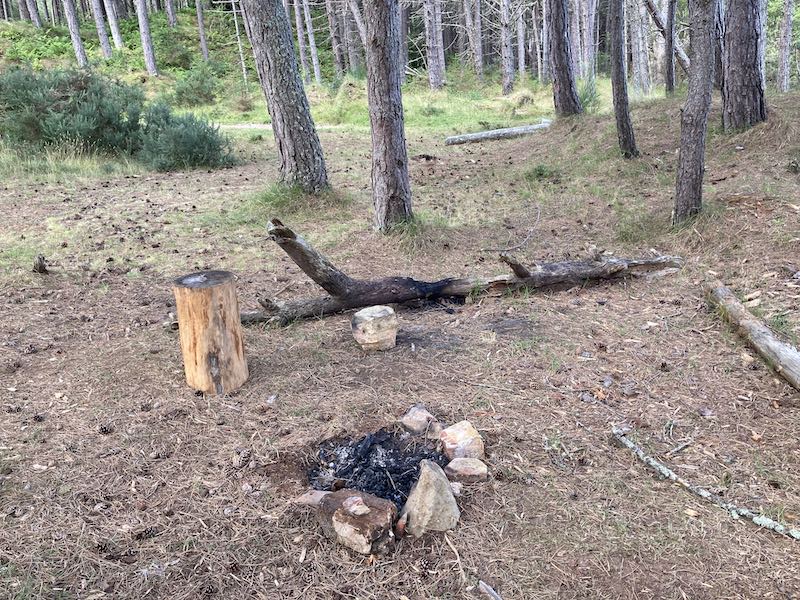
Campfires have fallen significantly at Glenmore Forest Park following the introduction of new restrictions, but Forestry and Land Scotland is warning that fires remain a serious problem across the country’s forests and woodlands.
Staff patrols at Glenmore, within the Cairngorms National Park, have recorded a marked reduction in campfires since a seasonal fire byelaw was introduced this year.
The improvement is being welcomed by Forestry and Land Scotland, although a minority of visitors are still ignoring the restrictions.
Paul Hibberd, FLS Regional Visitor Services Manager for the area, said:
“Encouragingly patrols by FLS staff in Glenmore, which sits in the Cairngorms National Park, have shown a significant decrease in campfires this year.
“But fires are still a worrying issue with a minority of people not adhering to the new byelaw.”
The picture elsewhere shows why forestry staff remain concerned.
On Skye, visitors have already been urged to behave responsibly following evidence of campfires, littering and other problems at sites across Skye and Lochalsh.
In Highland Perthshire, numerous No Fires signs have been installed around Loch Tummel and Loch Rannoch, with daily patrols being carried out alongside Perth and Kinross Council staff.
Despite those measures, significant numbers of campfires are still being discovered.
FLS East Regional Visitor Services Manager Justin Livesey said:
“In our coastal forests such as Tentsmuir, fires are becoming a regular occurrence and we have on several occasions required attendance and assistance from the Scottish Fire and Rescue Service.
“In highland Perthshire, we have installed numerous ‘No Fires’ signs around Loch Tummel and Loch Rannoch and undertake daily patrols in partnership with Perth and Kinross Council staff.
“Despite these efforts, we continue to find significant numbers of campfires, many of which are large and have the potential to cause serious damage.”
Some incidents have already required intervention from firefighters.
At Glentress, smouldering logs from a campfire rolled down a bank and ignited dry grass before the fire began to spread.
Another incident involved a bin fire after a barbecue had not been properly extinguished before being thrown away.
Forestry staff are also finding burned wood and other fuel containing rusty nails, screws and metal staples, creating another hazard for visitors, pets and wildlife.
The incidents are putting additional pressure on staff while highlighting the difficulty of managing fire risks at popular outdoor destinations.
FLS Head of Visitor Services Stuart Chalmers said:
“One of the biggest threats to our woodlands is a disposable BBQ or a well-meaning campfire.
“That’s why we are asking everyone to protect Scotland’s landscape and most importantly our communities by swapping the campfire for a camping stove.”
Visitors are being asked to obey local restrictions, avoid fires and solid fuel barbecues, take litter home and leave no trace behind.
Any wildfire should be reported immediately by calling 999 and asking for the Fire and Rescue Service.
The reduction at Glenmore shows that clear restrictions can change behaviour.
The continuing problems elsewhere show why the warnings are still needed.


