

Orkney Islands Council has confirmed that Scottish Government funding will allow Phase One of its long awaited Ferry Replacement Programme to move ahead, following confirmation in the 2026 to 27 Scottish Budget.
The commitment means the Council can now progress plans to replace the ageing ferries serving the routes between Kirkwall and the islands of Eday, Sanday, Stronsay and Westray, vessels that many islanders rely on daily for work, education, healthcare and basic connectivity.
The funding decision follows years of negotiation between the Council and the Scottish Government through the Ferries Taskforce, a group established in December 2022 by then Finance Secretary John Swinney to address the growing risks posed by Orkney’s ageing internal ferry fleet.
Rather than appearing as a single capital line in the Scottish Government budget, the funding has been agreed through increased recurring revenue support for inter island connectivity, which the Council will use to underpin borrowing for new vessels in a model similar to a long term mortgage.
Council leaders say this approach, while less visible on paper, gives Orkney more flexibility and control over how and when the programme is delivered, and has already allowed work to progress on vessel design, community consultation and early engagement with shipyards.
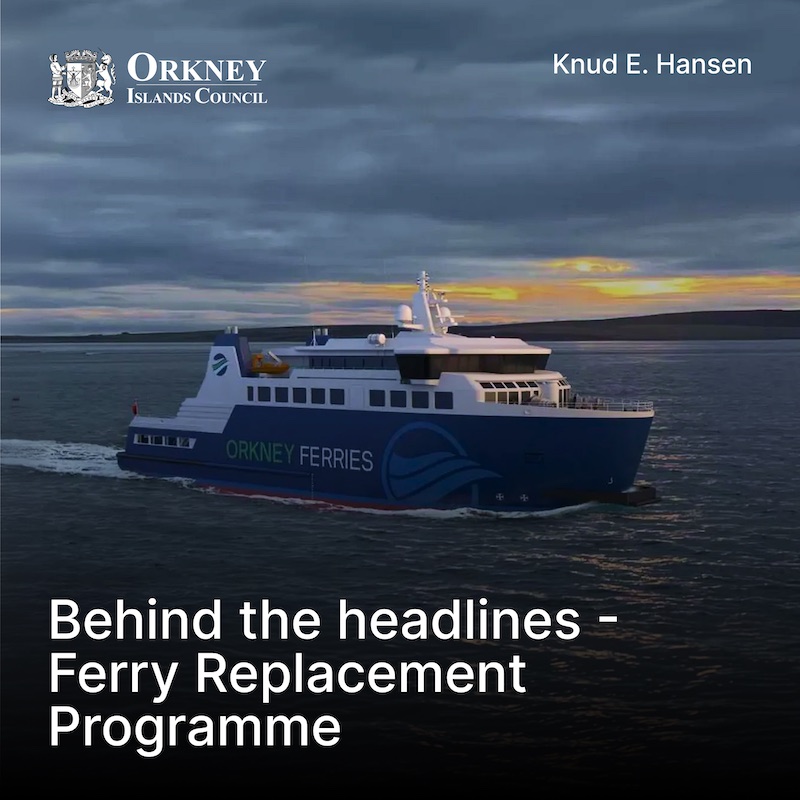
Phase One centres on three new large ferries, up to 60 metres in length, designed to operate on existing piers and harbours to avoid costly and time consuming infrastructure upgrades across the islands.
The proposed vessels will carry up to 190 passengers, significantly more vehicles than the current fleet, and include modern accessibility features such as lifts, quiet spaces, family seating, medical rooms, pet lounges and flexible energy systems capable of adapting to future low carbon technologies.
The final outline design is the result of extensive testing and consultation, involving ferry crews, island communities, community councils and public meetings held across Eday, Sanday, Stronsay, Westray and Kirkwall.
After detailed analysis by marine engineers Leadship Design and Consulting, and simulator testing in challenging weather conditions, a conventional monohull design was selected as the safest and most reliable option for Orkney’s seas, a conclusion fully endorsed by Orkney Ferries crews.
Council officials argue that while borrowing carries financial risk, the greater danger lies in continuing to rely on vessels that are now more than 35 years old, increasingly difficult to maintain, and vulnerable to breakdowns that disrupt island life.
With Phase One now financially viable, future meetings of the Ferries Taskforce will turn their focus to Phase Two, which will cover the Inner North Isles, South Isles, and routes serving Papa Westray, North Ronaldsay, Graemsay and Hoy.
That next phase will examine both new vessels and the pier and harbour upgrades required to support them, with further community consultation planned as designs develop through 2026.
For Orkney’s island communities, the funding confirmation represents a significant step away from uncertainty and towards a more resilient, reliable ferry network that underpins everyday life across the islands.


