

Rising business rates on Highland hydroelectric schemes could leave less money available for peatland restoration, woodland creation and wildlife habitat improvements, an MSP has warned.
Andrew Baxter, who represents Skye, Lochaber and Badenoch, has challenged the Scottish Government to consider the wider environmental consequences of increasing rates liabilities for rural estates generating renewable electricity.
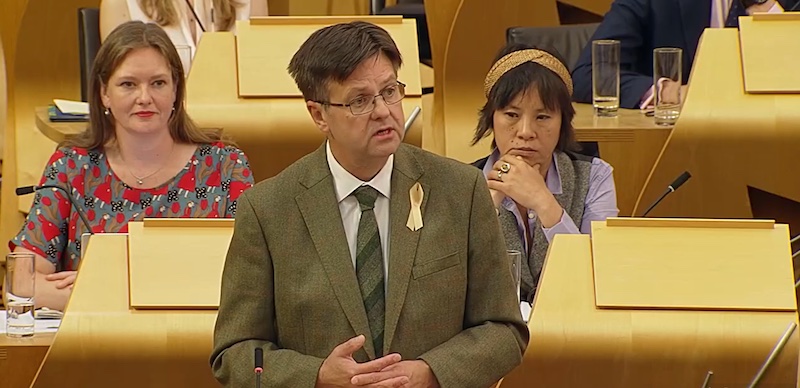
Speaking during questions at the Scottish Parliament, Baxter argued that income from hydro schemes often supports conservation projects and improvements to the surrounding countryside.
When more of that income is absorbed by business rates, he warned, landowners may have less money available to invest in environmental work.
The issue has attracted growing attention within Scotland’s hydroelectric industry, particularly over how infrastructure associated with generating electricity is assessed for non domestic rates.
Some operators have questioned the treatment of penstocks, the pipes that carry water to hydro turbines, under existing valuation regulations.
The dispute has also led to legal proceedings concerning the interpretation of Scotland’s business rates legislation.
During the parliamentary exchange on Tuesday 27 October, Energy Minister Stephen Gethins acknowledged the availability of financial relief for qualifying hydro schemes.
He confirmed that schemes with a rateable value of no more than £5 million may qualify for 60% rates relief and offered to discuss Baxter’s concerns directly.
The relief is currently available until March 2032, although eligibility depends on the circumstances of individual schemes.
Baxter welcomed the minister’s willingness to engage but argued that the wider financial pressures facing operators still required attention.
“Hydro schemes can provide more than renewable electricity.
“The income they generate can help fund peatland restoration, woodland creation and improvements to habitats across the Highlands.
“When increasing rates liabilities, because of complicated technical regulations, eat into that income, there is less money available for those projects.
“Ministers need to consider the wider consequences for the environmental work they say they want to encourage.”
Baxter questioned the consistency between the Government’s environmental ambitions and the financial pressures he believes are being placed on landowners investing in renewable energy.
“I welcome the minister’s willingness to discuss these concerns and look forward to meeting him.
“The availability of rates relief is part of that discussion, but it does not remove the need to examine the pressures schemes face and what more can be done.
“Landowners investing in renewable energy and putting income back into environmental improvements deserve a government that helps those efforts succeed.”
The Scottish Government maintains that valuations are determined by independent Scottish assessors working within the relevant legislation and case law.
Gethins also told Parliament that he could not comment on matters involving ongoing rating appeals.
The discussion leaves a wider question about how renewable energy taxation can accommodate environmental projects funded through hydroelectric income.
For rural estates across the Highlands, the outcome could influence how much funding remains available for restoring peatlands, creating woodlands and protecting natural habitats.
Baxter now intends to pursue those concerns directly with the minister.


