

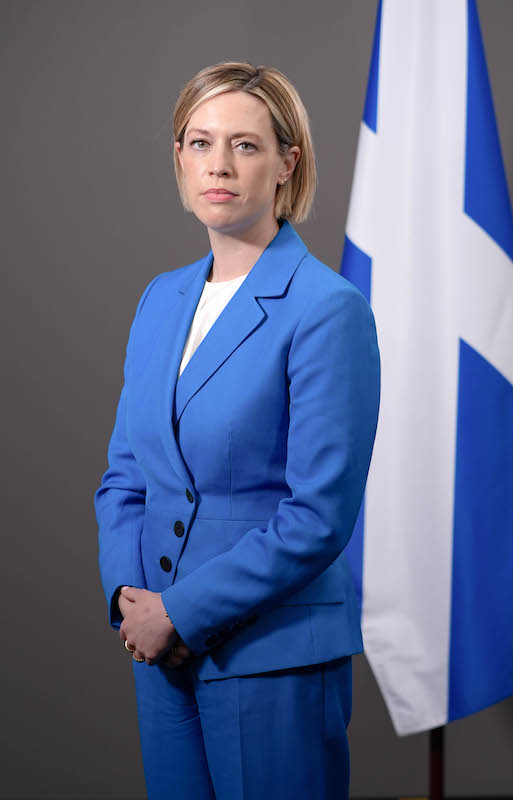
Scotland’s Deputy First Minister Jenny Gilruth will address the Plaid Cymru conference on Friday 2 October, where she is expected to argue that pro independence MPs from Scotland and Wales could hold the balance of power following the next UK general election.
Her appearance comes less than three weeks after First Ministers John Swinney and Rhun ap Iorwerth signed the Cardiff Agreement, establishing closer cooperation between the Scottish and Welsh governments across a range of shared priorities.
The agreement covers tackling child poverty, the cost of living, improving living standards, sustainable economic growth, climate resilience, international engagement including relations with the European Union, and the importance of language, culture, media and sport.
Gilruth is expected to use her conference speech to turn that growing cooperation towards Westminster and the potential influence of Scottish and Welsh MPs following the next general election.
She is expected to say:
“The next Westminster election, whenever they decide to call it, represents a moment of incredible opportunity for our nations.
“As well as pro-independence First Ministers leading our countries, for the first time in our history we could send two blocs of pro-independence MPs to the House of Commons.
“That would of course be a powerful symbol that Westminster’s time is up.
“But it can be more than a symbol.
“The fact is that the reason Labour are so far shying away from calling an early election is because they know they’re going to lose their majority.
“Westminster is heading for a hung Parliament.
“And in that very likely scenario, it can be Scotland and Wales that hold the balance of power.”
The suggestion that Westminster is heading for a hung Parliament and Gilruth’s claim about Labour’s reasons for not calling an early election are political arguments which she is expected to make in her speech rather than established outcomes.
The Cardiff Agreement itself was signed by the First Ministers of Scotland and Wales on 14 September and provides a framework for closer cooperation between the Scottish and Welsh governments while leaving both administrations responsible for their own policies and democratic mandates.
The two First Ministers said at the time that Scotland and Wales faced many shared challenges and could benefit from exchanging expertise and working more closely on policy development and delivery.
Their agreement also states that the people of Scotland and Wales should be able to determine their own constitutional futures, although the two countries remain on different constitutional paths.
Gilruth’s appearance at the Plaid Cymru conference will now provide another highly visible demonstration of that developing political relationship, with the Deputy First Minister expected to present cooperation between pro independence politicians in Scotland and Wales as potentially significant far beyond the devolved governments themselves.
The parliamentary arithmetic after the next general election cannot be known in advance, but Gilruth’s message to Plaid Cymru will be clear enough: if Westminster produces a Parliament without an overall majority, she believes MPs from Scotland and Wales could find themselves with considerably greater influence over what happens next.


