

I recently discovered that Britain introduced income tax to help defeat Napoleon, which initially seemed reasonable until I checked the historical records and found that Napoleon had been dead since 1821, while the government was still collecting the money.
This concerned me sufficiently to begin an investigation into whether anybody in Westminster had been informed that the war was over.
Income tax was introduced by William Pitt the Younger in 1799, abolished in 1802, revived in 1803 and abolished again in 1816, following Napoleon’s defeat at Waterloo.
The public were so pleased to see it disappear that Parliament ordered the destruction of records relating to the tax, although this precaution proved insufficient to prevent Sir Robert Peel reintroducing it in 1842.
Peel’s income tax was intended as a temporary measure, initially lasting three years, but successive governments discovered that extending it was considerably easier than finding the money elsewhere.
William Gladstone subsequently hoped to abolish it by 1860, although the Crimean War interfered with that particular ambition.
Exhibit A — Income Tax
| Year | What happened |
|---|---|
| 1799 | Introduced to finance war against France |
| 1802 | Abolished |
| 1803 | Reintroduced |
| 1816 | Abolished after the Napoleonic Wars |
| 1842 | Reintroduced as a temporary measure |
| 1853 | Gladstone envisages eventual abolition |
| 1914–18 | Wartime rates increase dramatically |
| 2026 | Still being collected |
I was beginning to suspect that Westminster operates a different calendar, under which temporary means until further notice, and further notice is delivered exclusively to an address that no longer exists.
My investigation then led me to David Lloyd George, who introduced Britain’s first petrol duty in 1909, charging motorists three old pence per gallon.
The duty was abolished in 1919, which briefly restored my confidence in the possibility of taxation ending, until I discovered that Winston Churchill had reintroduced it in 1928 at four old pence per gallon.
Churchill subsequently became famous for defeating Nazi Germany, although his earlier contribution to the taxation of British motorists has proved considerably more enduring.
I decided that the only responsible course of action was to investigate the consequences personally, so I retrieved my concessionary bus pass and boarded an Ember electric bus bound for Fort William, reasoning that travelling in a vehicle which required no petrol would prevent me from contributing further funds to a taxation system I was already beginning to distrust.
The journey also gave me an opportunity to consider the remarkable fact that the government was prepared to transport me across the Highlands at public expense so that I could investigate how much money it was collecting from everybody else.
Exhibit B — Petrol Duty
| Year | What happened |
|---|---|
| 1909 | Lloyd George introduces petrol duty at 3 old pence per gallon |
| 1919 | Petrol duty abolished |
| 1928 | Churchill reintroduces it at 4 old pence per gallon |
| 2022 | Temporary 5p-per-litre reduction introduced |
| 2026 | Duty stands at 52.95p per litre |
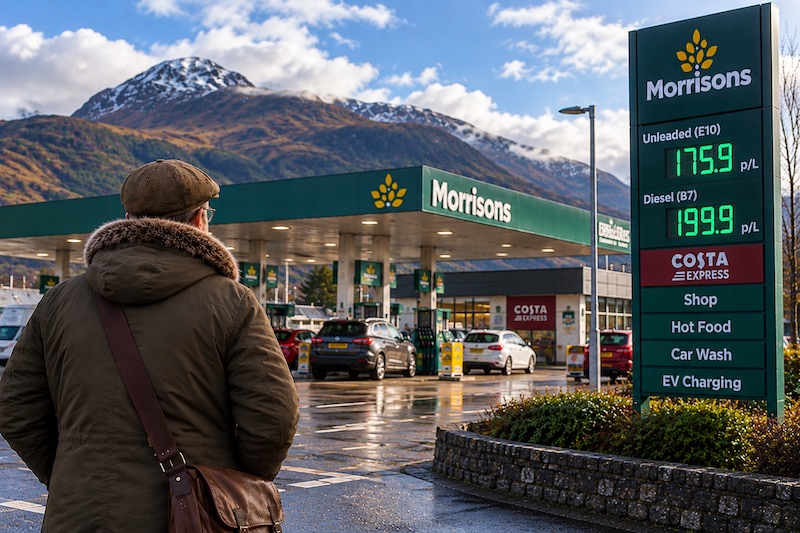
On arriving in Fort William, I made my way to Morrisons on Carmichael Way, where unleaded petrol was listed at 175.9 pence per litre, which I rounded to £1.76 to avoid introducing unnecessary complications into an investigation that was already becoming financially distressing.
Exhibit C — Where Your Petrol Money Goes
Based on £1.76 per litre and a 50-litre fill.
| What you pay | Per litre | 50 litres |
|---|---|---|
| Petrol at the pump | £1.76 | £88.00 |
| Fuel duty | 52.95p | £26.48 |
| VAT | 29.33p | £14.67 |
| Total tax | 82.28p | £41.15 |
| Share going in tax | 46.75% | 46.75% |
I had discovered that filling a car with £88 worth of petrol handed £41.15 to the Treasury in fuel duty and VAT, including £5.30 in VAT charged on the fuel duty itself, despite nobody from HMRC having offered to wash my windscreen.
This meant the government was not merely taxing the petrol but taxing the tax it had already imposed upon the petrol, an arrangement I suspected would be considerably less popular if introduced by a man wearing a balaclava.
I considered asking whether the Treasury would permit me to charge VAT on my council tax, but decided that opening negotiations might prove unwise.
My attention then turned to VAT itself, introduced in 1973 at 10 per cent to replace purchase tax, which had been introduced during the Second World War in 1940.
Purchase tax had survived the end of the war by almost 28 years, before disappearing into a replacement system which would eventually charge considerably more.
In 1991, VAT increased to 17.5 per cent to help finance reductions in the poll tax, which was subsequently abolished, although the increased VAT rate remained.
Following the financial crisis, VAT was temporarily reduced to 15 per cent in December 2008, restored to 17.5 per cent in January 2010 and then increased to 20 per cent in January 2011 as part of deficit reduction measures.
Unlike Peel’s income tax, the 2011 increase was not presented as a temporary measure, although I felt this demonstrated that the Treasury had finally learned the administrative advantages of making no promises whatsoever.
Exhibit D — VAT
| Year | What happened |
|---|---|
| 1940 | Wartime purchase tax introduced |
| 1973 | VAT replaces purchase tax at 10% |
| 1979 | Standard VAT reaches 15% |
| 1991 | Raised to 17.5% to help reduce poll tax |
| 2008 | Temporarily cut to 15% |
| 2010 | Restored to 17.5% |
| 2011 | Increased to 20% |
| 2026 | Still 20% |
I had now encountered three historical figures, several wars, a financial crisis, an abolished poll tax and a remarkably consistent reluctance to surrender revenue.
For comparison, I consulted The Official Loch Ness Monster Sightings Register, where extraordinary claims about an unidentified creature are recorded and assessed without requiring witnesses to pay VAT on the sighting, duty on the loch water or a supplementary levy for failing to produce photographic evidence.
It struck me that Nessie, despite an uncertain existence, was subject to a considerably more transparent evidential process than some of the country’s longest-surviving taxes.
Napoleon is dead, Lloyd George is dead and Churchill is dead, yet the taxes introduced or revived in their eras continue to make substantial contributions to the public finances.
I accept that governments require money to fund public services, and that today’s taxes are not necessarily collected for the same purposes as their historical predecessors, but I remain interested in why measures introduced as temporary solutions can become permanent features of national life.
I have consequently opened a new file entitled Temporary, which I intend to close as soon as the investigation is complete.
Based on the available historical evidence, this may take some time.
If you have any conspiracies you would like Aye to investigate, email conspiracycorner@thehighlandtimes.com


