

Almost one in four adults in Scotland believe current Relationships, Sexual Health and Parenting education is failing to help children understand online abuse, according to new research published by the NSPCC.
The charity says the findings underline an urgent need for change, as provision of RSHP education across Scotland remains inconsistent and dependent on local decisions rather than a national standard.
A YouGov poll commissioned by the NSPCC and carried out with more than 1,000 adults across Scotland found that 24 per cent believe current RSHP education does not adequately prepare children to understand online abuse, while 95 per cent said it was important that online safety and digital relationship risks are covered in schools.
More than two thirds of those surveyed, 67 per cent, also believe RSHP education should be compulsory.
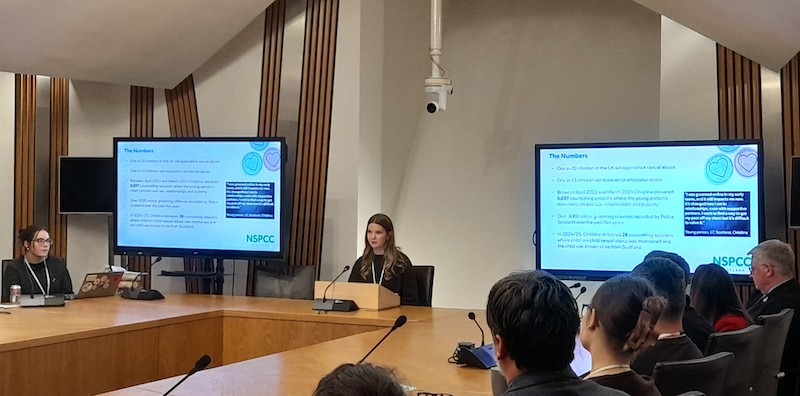
The findings were highlighted at an event held at the Scottish Parliament on 14 January, where the NSPCC renewed its call for a statutory duty requiring all schools in Scotland to deliver age-appropriate, consistent relationships and sex education.
The event, sponsored by Martin Whitfield, was led by young people and focused on the real-world impact of gaps in education around online safety, consent and abuse.
During the event, the experience of Aoife, 22, from East Kilbride, was shared, describing how she was sexually exploited online at the age of 15 by an older man posing as a teenage boy.
Aoife, now an NSPCC Lived Experience Advocate, said:
“Through what started as a casual conversation online, he was able to start controlling what I did in real life, within a matter of hours.
“I remember it was 3am and I was sitting in my room, just shaking.
“I felt like I was the only person in the world and started crying.
“I want to help to make children safer online by sharing my story because, right now, the online world isn’t safe enough.
“I would like to help prevent other young people from going through the same experience as me in the future.”
Aoife also urged young people to speak out if they experience abuse, saying:
“If any other young person experiences this, I’d urge them to tell an adult they trust straight away.
“It feels like the worst thing in the world at the time but telling a trusted adult is the only way you can get the help you need.”
Another NSPCC Lived Experience Advocate, Rachel Talbot, 19, from Angus, spoke about how RSHP education was delivered in her school.
“At my school RSHP was taught the same way as English or Maths which made the whole experience incredibly awkward and difficult to properly engage with class discussions.
“The online world is such a central part of growing up now and young people need to know how to look out for themselves in these spaces.”
While RSHP sits within the health and wellbeing strand of Scotland’s Curriculum for Excellence, councils and schools currently decide how and when it is taught, leading to what the NSPCC describes as patchy and insufficient provision.
Joanna Barrett, NSPCC Associate Head of Policy, said:
“Unfortunately, we know from our work with young people across Scotland that not all pupils receive relevant and consistent relationships, sex and health education.
“Young people have a right to this fundamental education, and to be involved in influencing the way it’s delivered, so that it’s up-to-date and relevant to them.”
The NSPCC is calling for RSHP education to be made mandatory, better resourced and given greater priority within the curriculum, to help protect children from harm both online and offline.
Young people looking for support on any of the issues mentioned, can contact Childline on 0800 1111 or visit Childline.org.uk
Childline is available to all young people until their 19th birthday.


