

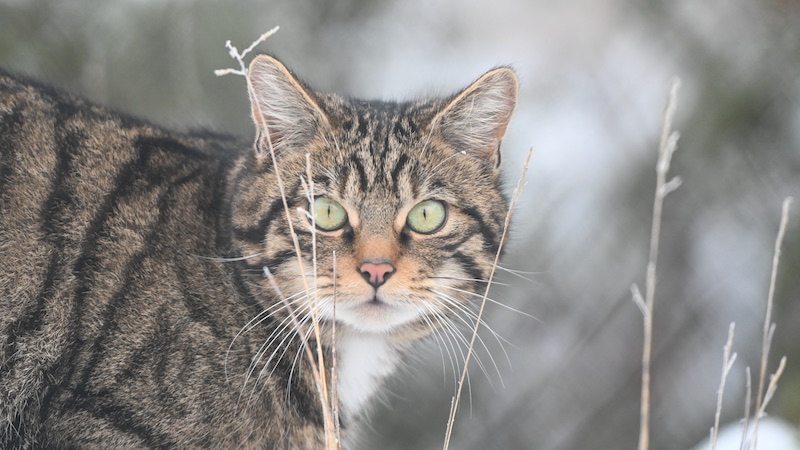
Scotland has launched a new 20 year strategy aimed at restoring wildcats to sustainable populations and allowing the country’s only remaining native cat to expand across its former range.
Scotland’s Wildcat Strategy 2025 to 2045 was unveiled at Highland Wildlife Park in Kingussie on Tuesday 22 September, bringing together more than 25 organisations behind a long term recovery plan for the species.
Wildcats were once found throughout mainland Britain but centuries of persecution and other pressures pushed the population towards extinction, with the species declared functionally extinct in Scotland in 2019.
There are now signs of hope in the Cairngorms, where the Saving Wildcats partnership began releasing wildcats into the national park in 2023.
Those animals have established territories and successfully bred in the wild, with the first wild born kittens recorded the following year.
The new strategy aims to build on that progress and eventually establish thriving wildcat populations across a much wider area of Scotland.
One of the greatest challenges remains hybridisation, where wildcats interbreed with feral and domestic cats and gradually lose their genetic distinctiveness.
The strategy therefore calls for increased microchipping, neutering and vaccination of pet cats alongside work to restore and reconnect wildcat habitat.
Further carefully planned conservation releases into new areas will also be required if the species is to expand beyond its current recovery areas.
Other threats include disease, road collisions, habitat fragmentation and accidental harm caused by predator control activities.
Climate Action and Rural Affairs Secretary Gillian Martin said:
“This new strategy builds on these early successes to begin to imagine a nationwide recovery of the species.
“I would like to thank all of the individuals and partner organisations for their work and dedication to get to this point and look forward to even greater success in the decade to come.”
NatureScot Species Projects Manager Martin Gaywood said:
“Scotland’s wildcats have been brought to the brink of extinction, but conservation efforts over the past two decades have seen our only remaining native cat returned to the wild through the Saving Wildcats partnership project, establishing new territories in the Cairngorms National Park and breeding successfully.
“This progress wouldn’t have been possible without partners and communities coming together.
“Now we call on this support again, to drive forward the further change we need to happen.
“Scotland’s Wildcat Strategy is our call to action.”
The strategy is backed initially by a 10 year action plan, while a new Scottish Wildcat Advisory Group will bring key organisations together to oversee the work ahead.
For a species which only a few years ago was considered functionally extinct in Scotland, the ambition for 2045 represents a remarkable change in direction.
The challenge now is to turn the first tentative recovery taking place in the Cairngorms into something much bigger, with wildcats once again able to thrive across Scotland.


