

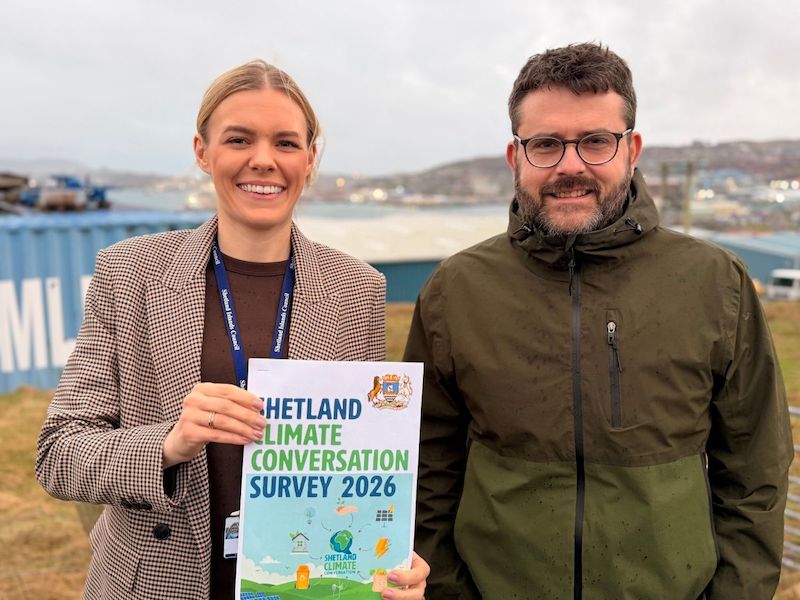
People across Shetland are being invited to share their views on climate change as Shetland Islands Council launches its second Climate Conversation Survey.
The six week survey is now open and will run until 9 March, asking residents to reflect on how climate change affects their lives and their community.
Participants are being asked for their views on areas including transport, health and the environment, and how these issues are linked to climate change in Shetland.
The survey also asks people to identify their top three priority areas for tackling climate change, what concerns them most about its impact locally, and what actions they are already taking at home.
The new survey follows on from the Council’s first Climate Conversation Survey in 2021 and offers an opportunity to understand whether community attitudes have shifted over the past five years.
More than 800 responses were received in 2021, with around 80 percent of respondents believing there was a climate emergency.
At that time, the main priorities identified were transport including aviation and shipping, energy supply, and business and industry.
The Council says the results of the earlier survey helped inform policy development and funding decisions.
Team Leader for the Climate Change Strategy Team at Shetland Islands Council, Claire Ferguson, said:
“This is a great opportunity for us to hear from the community about climate change and what that means from a Shetland perspective.
“Our first survey showed that people really care about the environment and their communities, and that lots of people are making positive changes at home.
“It’s also fed into our work as to how we as a Council can tackle climate change while supporting the community and bringing positive benefits.
“As an example, information gained in the 2021 survey was used to inform the funding application to Innovate UK for the Brae Rural Energy Hub project.
“I’d encourage as many people as possible to fill in the survey as this will shape our work in future and help to put more projects on the ground that are aligned to, and focussed on, community priorities.”


