

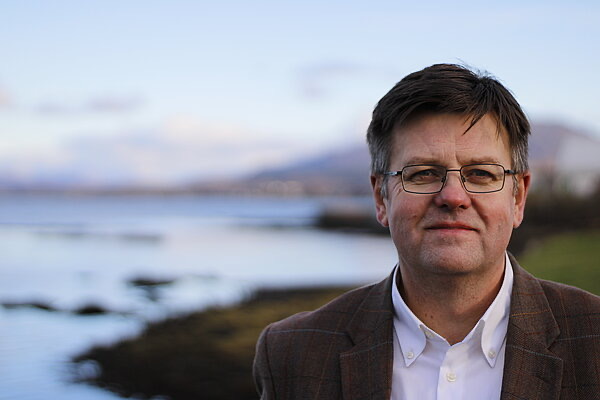
Andrew Baxter has called for a new parliamentary committee to oversee scrutiny of the long delayed A9 dualling programme as pressure continues mounting on the Scottish Government over the future of the project.
The MSP for Skye, Lochaber and Badenoch has written to the Presiding Officer of the Scottish Parliament requesting the creation of a dedicated A9 Dualling Programme Committee at Holyrood.
The proposal follows recommendations made by the Citizen Participation and Public Petitions Committee during its inquiry into the A9 dualling programme.
For years the A9 has remained one of the Highlands’ most politically sensitive infrastructure projects with repeated delays fuelling frustration across communities and businesses reliant on the route.
The Scottish Government first committed to fully dualling the road between Perth and Inverness almost two decades ago.
Large sections of the route remain single carriageway despite ongoing safety concerns and longstanding criticism from campaigners and local communities.
Baxter said stronger parliamentary scrutiny is now required to ensure progress is finally delivered.
Speaking today, he said:
“It took NASA 11 years to put a man on the moon, but the SNP still haven’t come good on a near 20 year old promise to dual the A9.
“Dualling the A9 is vitally important for all of the Highlands, to both make the road safer and to boost the Highland economy.
“I am determined to ensure the needs of the Highlands are heard loud and clear at Holyrood.
“That is why I believe we need to look to what more Parliament can do to hold the Scottish Government’s feet to the fire to finally dual the A9.”
The A9 remains the main road artery connecting much of the Highlands to the Central Belt and has long been viewed as critical infrastructure for tourism, freight, emergency services and economic development across northern Scotland.
Campaigners have repeatedly argued that delays in completing the dualling programme have not only damaged economic confidence but continue to raise serious road safety concerns.
The issue has also become increasingly symbolic politically, with opposition parties regularly accusing the SNP of failing to deliver one of its most high profile transport promises.
The proposed parliamentary committee would focus specifically on oversight, accountability and scrutiny of progress across the dualling programme as work continues on remaining sections of the route.
For many across the Highlands though, the frustration increasingly centres on the gap between promises made and visible progress on the ground.
Andrew Baxter MSP’s letter to the Presiding Officer is as follows:
Dear Presiding Officer,
Firstly, may I congratulate you on your election as Presiding Officer of the Scottish Parliament. As a newly elected member of Parliament, I look forward to your advice and encouragement as I learn how best to use my privileged parliamentary position for the benefit of my constituents and the wider Highlands.
During your statement to Parliament on 21 May regarding proposed changes to the Parliamentary timetable, you remarked: “We want this Parliament to be more impactful and effective, so please feel free to discuss with me.” I am taking you up on that offer.
I am writing to seek your consideration and support for the establishment of a dedicated Parliamentary committee with a specific remit to scrutinise the A9 Dualling Programme.
As you will be aware, this was a key recommendation of the Citizen Participation and Public Petitions Committee Inquiry into the dualling of the A9 programme, contained within its report published on 1 November 2024. The Committee concluded that a dedicated committee would “maintain momentum on scrutiny of a long-running, multisession infrastructure project of this nature” and specifically invited the Parliamentary Bureau to consider how such a committee could be established.
Importantly, in the Scottish Government’s response to the Committee, the Cabinet Secretary for Transport stated on 9 January 2025 that: “The Government considers that the recommendation for establishment of a dedicated Parliamentary Committee is clearly a matter for Parliament to reach a view on.”
As we enter a new parliamentary session, Parliament now has the opportunity to take the bold step of establishing such a committee — not only to strengthen oversight of the A9 programme itself, but also to create a model for the scrutiny of future major infrastructure projects which extend across multiple parliamentary sessions.
One of the strongest arguments in favour of a dedicated committee is the ability to build and retain institutional expertise over the lifetime of a project. The A9 programme will continue well into future parliamentary terms and requires sustained, informed and forensic scrutiny. A committee with a focused remit could build up expertise on the complex issues and delivery challenges involved, while providing regular opportunities to hold ministers, Transport Scotland officials and delivery agencies properly to account. in this regard, there is a clear precedent in the committee arrangements established during delivery of the Queensferry Crossing project. That model demonstrated the value of focused parliamentary oversight for a nationally significant infrastructure project.
Former MSP Fergus Ewing recently argued that a dedicated committee would help “ensure no more backsliding and delays” by providing sustained scrutiny and regular evidence sessions with ministers, civil servants and Transport Scotland officials. Whether one agrees entirely with that assessment or not, I believe there is broad consensus that Parliament must strengthen its ability to scrutinise long-term infrastructure delivery and rebuild public confidence where timelines have drifted significantly.
I do not anticipate that such a committee would create a disproportionate additional burden on parliamentary authorities. A committee meeting every three or six months could provide meaningful oversight without requiring an intensive meeting schedule. Indeed, it could reduce pressure on the Net Zero, Energy and Transport Committee — or its successor committee — whose remit is already exceptionally broad and demanding.
In your statement to Parliament, you also said that “Parliament needs renewal and re-engagement” and that we should seek to “make Parliament more efficient, topical and effective for those we represent.” I believe the establishment of a dedicated A9 scrutiny committee would reflect precisely those ambitions by strengthening the role of Parliament, improving transparency and enabling more effective scrutiny of ministers and public agencies responsible for delivering nationally significant projects.
I appreciate that decisions on committee structures involve discussions across the Parliamentary Bureau and party groups, but I would be grateful if you would give consideration to this proposal and the recommendations made by the previous Parliament’s Petitions Committee as discussions on parliamentary business and committee structures continue.
Thank you for your consideration and I look forward to working constructively with you during this parliamentary session.
Andrew Baxter MSP
Liberal Democrat – Skye, Lochaber and Badenoch


