

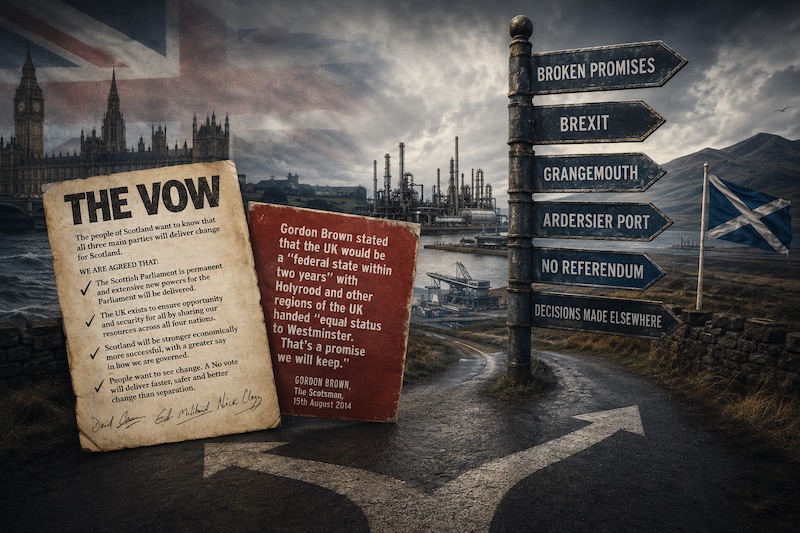
Tomorrow Scotland votes again, and before a single ballot paper is counted it is worth remembering just how many promises have been made to Scotland by Westminster politicians over the years, because Scottish politics is littered with grand declarations, dramatic speeches and solemn guarantees that arrived with fanfare before quietly fading quietly into the background once the votes were secured.
The Scottish branches of Labour, the Conservatives and the Liberal Democrats have too often acted less like independent Scottish parties and more like regional offices answering upwards to Westminster leaderships whose priorities are shaped around holding power in England first and Scotland second, leaving many voters increasingly sceptical that decisions affecting Scotland are ever truly being made with Scotland’s long term interests at heart, particularly now as Reform attempts to establish itself north of the border while offering another version of a politics directed largely from London rather than rooted in the realities, needs and ambitions of Scotland itself.
Few examples capture that better than “The Vow”, the last minute promise made to Scotland in September 2014 as panic spread through the Westminster establishment during the final days of the independence referendum campaign, when David Cameron, Ed Miliband and Nick Clegg stood together to promise that a No vote would deliver extensive new powers for Holyrood, permanent protection for the Scottish Parliament and a stronger, more equal position for Scotland within the United Kingdom.
Gordon Brown went even further, speaking of a federal future where Scotland and the other nations of the UK would enjoy powers approaching equal status with Westminster itself, words that carried enormous weight at a moment when many undecided voters were wrestling with one of the biggest political decisions in modern Scottish history.
Twelve years later, many Scots look around and struggle to see the country that was promised.
Scotland remains rich in oil, rich in energy, rich in natural resources and rich in talent, yet communities across the country continue to battle poverty, declining industry and economic insecurity while the key levers of power remain firmly controlled from London, where decisions affecting Scotland are still routinely made by governments the country did not vote for.
Brexit only deepened that frustration, because Scotland voted clearly to remain in the European Union and was taken out anyway, against its democratic will, in a moment that fundamentally changed how many people viewed the Union itself, not simply as a partnership of nations but increasingly as a system where Scotland can express an opinion yet still be overruled when Westminster decides otherwise.
That feeling has only hardened as repeated requests for another independence referendum have been rejected time and again, leaving many voters asking how Scotland can be described as an equal partner while being denied the right to revisit its own constitutional future through the ballot box.
The closure of Grangemouth became another symbol of that wider anger, with Scotland losing its only oil refinery while Westminster offered little more than managed decline and vague promises about transition, despite the strategic importance of the site and the thousands of livelihoods connected to it, all while huge investment and industrial backing continued flowing into projects elsewhere in the UK.
Then came the decision surrounding Ardersier Port, where concerns about Chinese involvement suddenly became serious enough to halt progress in the Highlands despite Chinese companies continuing to operate across major infrastructure projects in England, including around nuclear development, a contradiction many Scots viewed as another reminder that Scotland is often treated differently when economic opportunities are on the table.
None of this happened under one Westminster party alone.
Labour made promises.
The Conservatives made promises.
The Liberal Democrats made promises.
Now Reform arrives offering its own answers, despite Scotland already carrying the scars of decades of decisions imposed from elsewhere.
That is why tomorrow matters.
Not because one election changes everything overnight, but because Scotland has heard enough promises to last a lifetime, and voters should be careful who they trust when the speeches grow louder and the guarantees start appearing once again.
Because in Scottish politics, history suggests the promises are usually made before the vote and forgotten afterwards.


