

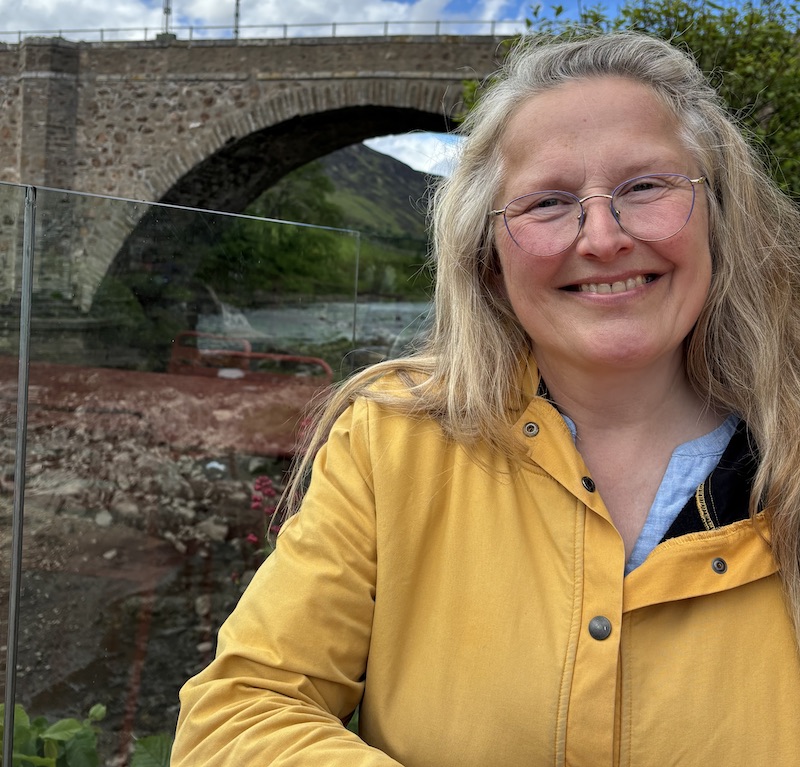
The economic and personal impact of unpaid caring responsibilities has been highlighted by East Sutherland and Edderton by election candidate Rebecca Machin as Carers’ Week 2026 draws to a close.
Mrs Machin said unpaid carers make an enormous contribution to families, communities and the wider economy, but often do so at considerable personal and financial cost.
She argued that carers, particularly women, frequently face reduced earnings, interrupted careers, lower pension savings and increased financial insecurity as a result of caring responsibilities.
Drawing on her own family experience, Mrs Machin reflected on the life of her mother in law and the challenges faced by many unpaid carers across Scotland.
“Unpaid care has severe economic consequences, carrying an estimated annual cost of up to £47.7 billion in lost labour in the UK alone.
“It forces millions out of the workforce, slashes household incomes, devastates long-term pension savings, and, if compensated fairly, would be worth roughly £180 billion annually to the economy.
“Unpaid care, at both ends of the age spectrum, child and adult fall disproportionately on women.
“My mother-in-law is a textbook study in the quiet tragedy of many women’s lives.
“Born in the war, she did everything right.
“Studious, obedient, she secured a place at university in 1960.
“Upon graduation, she spent the next 15 years as either a children’s social worker or a probation officer, helping the most vulnerable in society at their most vulnerable times.
“When she got married, it was to a man who was four years younger than her and had left school at 15 from a council estate with no qualifications.
“Honourably discharged from the Royal Navy for being disabled, his naval qualifications counted for nothing in civvy street and low skilled factory work was all that was available.
“She would have to be the breadwinner.
“When she had her only child, she was forced out of work by a lack of childcare.
“Eventually, they moved from a house they loved to a bungalow as her husband’s disability would progress and living near her in-laws was going to be necessary for when she had to return to work full time.
“Luckily, her in-laws were happy to take care of the child during holidays and after school.
“Although her bookcase contained Shirley Conran’s ‘Superwoman’ and the immortal phrase “life’s too short to stuff a mushroom” as well as Susie Orbach’s ‘Fat is a Feminist Issue,’ her life was being shaped by Thatcherite men-first patriarchal politics.
“As her husband, then his brother and finally her mother-in-law, became more disabled, she cared for them all, unpaid, with an ever-increasing workload for over 30 years.
“She did it with good humour.
“Always.
“She never complained.
“I remember waking up to her infectious laughter, cheerily helping her husband with his personal care in the early hours of the morning when we went to stay.
“Her unbreakable resilience astonished me.
“Eventually, as they died, and now retired, it looked like my mother-in-law would have the chance to travel and to indulge in some of the life which she had put on hold.
“She had topped up her state pension with dwindling savings and had a small local authority pension from her work in the public sector.
“Although diminished by her career breaks, she would be frugal and thought she could manage.”
Mrs Machin said the financial consequences of caring often continue long after caring responsibilities have ended.
“Carers are highly vulnerable to financial insecurity in later life.
“Giving up work or reducing hours to provide care leads to severely diminished lifetime earnings.
“Nearly half of all carers have zero private pension savings at age 60 to 65, and those who do save have 17% less than the national average.
“In the end, her reward was 18 months.
“By then, she was showing signs of Alzheimer’s and dementia.
“My partner and I took over her care.
“She is still alive.
“But the person she was, has gone.
“And we are left with memories and a shadow version of the vibrant, funny, caring woman I knew.
“This 1960s feminist who did everything she was told to do.
“Women are more likely to have career breaks and take lower paid work or junior roles to fit around caring responsibilities.
“It also means that more women than men are in receipt of social security payments, which in turn were cut, along with the services that provided support to carers by the austerity programme brought in by George Osborne and the Tory/Lib Dem coalition government of 2010.
“From 2010 to 2019 £540 billion had been cut, the two biggest reductions being local government funding and social security.
“It was a direct attack on women and carers.
“Women like my mother-in-law.
“This loving, hilarious and impish woman who made choices and lived with the consequences but who was being buffeted by socio economic forces way beyond her control.
“And those choices did have consequences: disrupting her work meant that, this middle class graduate who followed all the rules and never claimed benefits, is able to contribute less to her care now she needs looking after and it is society who is left to pick up the tab.
“An estimated 524,000 working-age unpaid carers are locked out of employment but could work with the right accommodations.
“Building carer friendly communities, and thinking about the right accommodations, can open up employment options for carers with the lifelong benefits.
“But it makes economic sense too.
“Working folk contribute more to the economy, with more spending power in our local shops and businesses, less dependence on benefits and greater contributions.
“It is good on an individual level, it is good on a society-wide level.
“All it takes is a little support and understanding from those in charge.”
Her comments come as organisations across Scotland continue to highlight the contribution made by unpaid carers and the challenges many face while supporting family members, friends and loved ones.


