

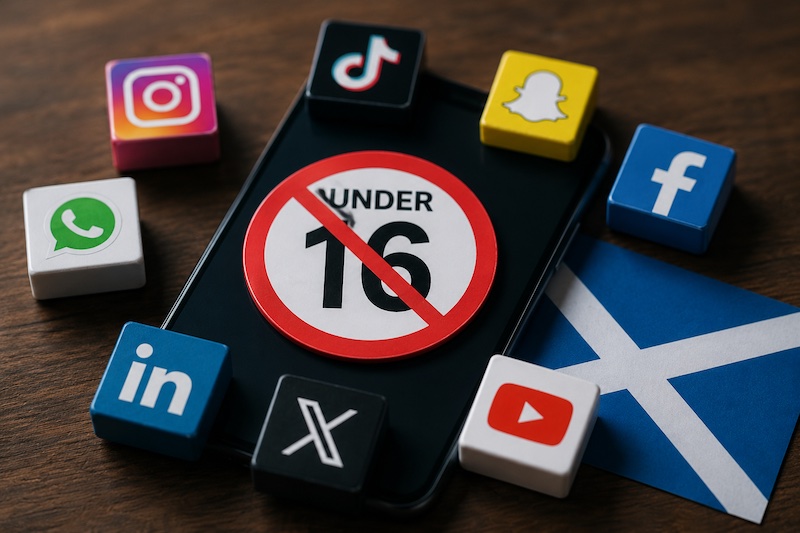
Scotland’s Children and Young People’s Commissioner has warned that a blanket ban preventing under 16s from accessing social media may not be the right solution to protecting children online.
Nicola Killean said the current evidence does not show that a full social media ban would be proportionate, effective or enforceable, arguing instead that stronger safeguards and greater accountability from technology platforms are needed.
The comments come as the UK Government continues consulting on proposals linked to its Growing Up In The Online World review, including the possibility of introducing a minimum age requirement for accessing social media platforms.
The Commissioner’s office carried out a children’s rights impact assessment examining both the positive and negative implications such a ban could have on young people.
The assessment also involved input from the office’s Young Advisors group made up of children aged between 12 and 17 from across Scotland.
Killean said while there are genuine concerns surrounding harmful content, cyberbullying, exploitation and online manipulation, social media also plays an important role in many young people’s lives.
“Evidence shows that social media can expose children to serious risks, including harmful content, cyberbullying, manipulation, contact from strangers, exploitation and excessive use.
“However, it also shows that social media can play an important role in many children’s lives by supporting communication, self expression, access to information, participation, play, and connection with communities and support networks.”
The Commissioner warned that a blanket ban risks shifting responsibility away from social media companies themselves while failing to address wider concerns around algorithms and platform design.
“The evidence so far on bans is limited, mixed, and still emerging.
“Blanket restrictions can risk shifting responsibility away from platforms and onto children.
“A ban does little to address underlying issues such as exploitative algorithms, and business models that drive harmful content and engagement.”
The report also raised concerns that certain groups of young people could be disproportionately affected by restrictions.
Children living in rural communities, disabled children, young people with overseas family connections and those relying on online communities for support or identity could all face unintended consequences from a ban.
Members of the Young Advisors group acknowledged both the positives and negatives of social media during the consultation process.
One young participant said:
“Social media is really good at allowing people to meet with similar interests to them which might not be popular in their community.”
Another added:
“I found social media easy to see content that’s not suitable for people my age and for younger groups.”
Instead of a blanket ban, the Commissioner has called for stronger rights protections for children under 18, tighter platform accountability and restrictions focused specifically on harmful features and functions rather than outright access.
The submission also recommends involving children and young people directly in future policymaking around online safety and social media regulation.


