

A generator failure during seabird research at Dunnet Head in Caithness has led to what is believed to be one of the first uses of renewable energy to power radar fieldwork at UHI North, West and Hebrides.
PhD researcher Amy Jones was using marine radar to monitor seabird activity during summer fieldwork when the unexpected breakdown left the team needing another way to power its equipment.
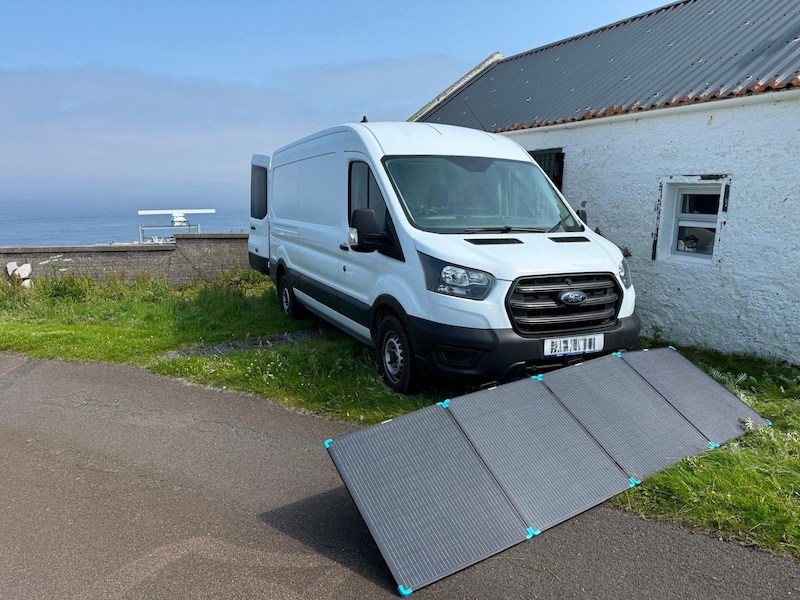
The answer was sitting rather conveniently in the form of portable solar panels, which were deployed beside the team’s fieldwork van.
The panels supplied electricity to the radar computer, display screens and data acquisition equipment inside the vehicle while also supporting the radar base station and antenna nearby.
It meant the research could continue without waiting for the failed generator to be replaced and with substantially less reliance on fuel.
What began as a practical solution to an unexpected problem quickly became a useful experiment in its own right.
Large radar systems used for this type of fieldwork are normally powered by mains electricity, generators or vehicle batteries because of their considerable energy requirements.
Renewable energy has increasingly been used to power radar elsewhere, but the Dunnet Head project is believed to be among the first occasions it has been used for radar fieldwork at the university.
The conditions needed for seabird radar surveys also turned out to be particularly well suited to solar power.
Researchers need relatively calm and dry weather both to protect sensitive equipment and to collect good quality data, with those same conditions often providing useful opportunities to generate solar energy.
The portable panels could be positioned beside the van and adjusted during each survey to take advantage of the available sunlight.
As well as keeping the project running, the switch reduced fuel consumption, generator emissions and noise at the field site.
Amy Jones, PhD Researcher, Environmental Institute, UHI North, West and Hebrides, said:
“What began as a practical response to equipment failure became a valuable demonstration of how renewable energy can support our research in remote locations.
“We were able to continue collecting important and energy-intensive radar data while reducing our reliance on a fuel-powered generator, which is a really positive outcome from an unexpected situation.
“It also aligns with our longer-term goal of making research more sustainable.”
The fieldwork was also supported by Louis Goldman, who provided the support vehicle and portable solar panels, with The Snowdon Trust funding the field support.
For a research team faced with a broken generator at one of mainland Britain’s most northerly points, an inconvenient failure ultimately demonstrated that some demanding scientific fieldwork can be powered rather differently.
To find out more about research at UHI North, West and Hebrides, please visit: Research – UHI North, West and Hebrides
UHI North, West and Hebrides would like to extend special thanks to Louis Goldman for use of his support vehicle and portable solar panels, and to The Snowdon Trust for funding this invaluable field support.


