

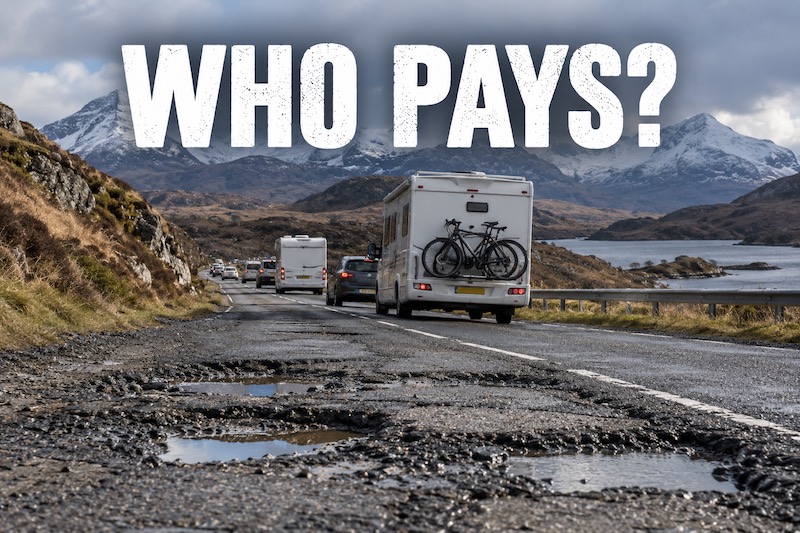
Highland Council’s proposed Visitor Levy has produced plenty of debate about what tourists and accommodation businesses could be asked to pay, but considerably less about who pays if the levy is rejected.
That question matters in a region welcoming around 9.4 million visitors a year while trying to maintain more than 4,000 miles of roads across an enormous geographical area.
Tourism is one of the foundations of the Highland economy, generating an estimated £2.129 billion in direct visitor spending during 2024 and supporting businesses and jobs across the region.
But millions of visitors also use roads, car parks, public toilets, waste facilities, paths and other infrastructure which has to be maintained whether a Visitor Levy exists or not.
Highland’s roads provide perhaps the clearest example of the problem.
The latest Scottish Road Maintenance Condition Survey found that 38.9% of the Highland Council road network requires maintenance treatment, leaving the authority ranked 28th among Scotland’s 32 councils.
The estimated backlog of capital road repairs across Highland has also been put at around £233 million, with councillors previously warning that without additional funding the network will continue to deteriorate.
Against that background, Highland Council is consulting on a Visitor Levy which it estimates could generate around £9 million every year.
The proposed charge is £5 per room or area per night for hotels, guest houses, B&Bs, self catering accommodation and similar properties, with a lower £2 charge applying to hostels, campsites and caravan parks.
There are legitimate arguments about those figures and whether the proposed charges have been set at the right level.
There is, however, another group with a direct interest in this debate.
The ordinary Highland resident.
Not everyone living in the Highlands owns a hotel, holiday let, restaurant or tourism business, and many households receive no direct income from the millions of people who visit the region every year.
They do, however, contribute through the existing system of public finances towards maintaining the infrastructure which residents and visitors share.
Visitors already make an enormous economic contribution through the money they spend while they are here, and the importance of that spending to Highland businesses and employment should not be understated.
But money spent on a hotel room, restaurant meal or attraction ticket does not go directly towards repairing the public road outside.
Somebody still has to pay for that.
That is why the debate surrounding the Visitor Levy cannot only consider what happens if Highland introduces it.
It must also consider what happens if Highland does not.
Rejecting the levy does not repair a pothole, maintain a public toilet, improve a car park, empty a bin or resurface a road.
Nor does it make the cost of providing those services disappear.
Highland Council says government funding is substantially based on population, while the authority has more than 4,000 miles of roads to sustain and a visitor population many times greater than its resident population each year.
The proposed Visitor Levy would create a new source of locally raised revenue from overnight visitors, with legislation restricting the net proceeds to supporting the objectives of the scheme and facilities and services used by visitors.
Under the legislation, the net proceeds from a Visitor Levy must be used to support the objectives of the scheme and to develop, maintain and sustain facilities and services used by visitors for leisure or business purposes.
That still leaves important questions about where the money would be spent and how the public could be certain that Visitor Levy income represented genuinely additional investment.
Those questions deserve scrutiny of their own.
But before deciding that visitors should not be asked to contribute directly towards the infrastructure they use, there is a much simpler question which needs an answer.
If they don’t pay, who does?


