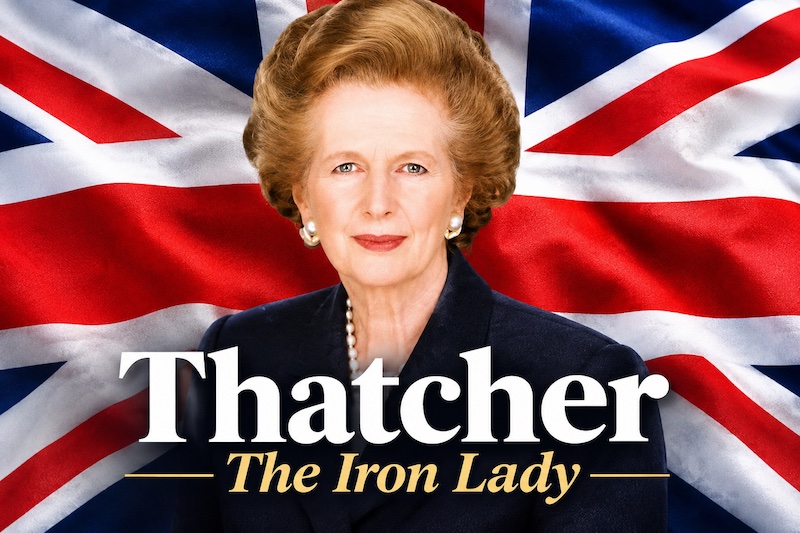
I have recently been examining the rather troubling possibility that many of Britain’s present difficulties can be traced back to one woman who left Downing Street 36 years ago and has been dead since 2013.
Her name was Margaret Thatcher, although she became better known as the Iron Lady, a title which suggests a degree of structural permanence that may prove relevant to this investigation.
Thatcher became Britain’s first female Prime Minister in May 1979 and remained in office until November 1990, during which time she embarked upon a programme of economic and social reform that fundamentally altered the country.
Her supporters credit her with rescuing Britain from economic decline, confronting powerful trade unions, encouraging enterprise and transforming Britain into a more competitive economy.
Her critics maintain that she dismantled industries, devastated communities, weakened collective responsibility and helped create a society increasingly concerned with money, property and personal advancement.
I intend to establish which account is supported by the evidence, although preliminary enquiries suggest that the matter may require considerably more than one investigation.
Scotland presents an especially interesting starting point because Thatcher won three successive UK general elections without ever securing the largest share of the Scottish vote.
In 1979, the Conservatives received 31.4 per cent of Scotland’s vote, falling to 28.4 per cent in 1983 and just 24 per cent in 1987.
Nevertheless, Scotland remained subject to the decisions of a government whose political philosophy was becoming increasingly unpopular north of the border.
The consequences were substantial, particularly for communities dependent upon coal mining, steelmaking, shipbuilding and manufacturing, where industrial decline brought unemployment, financial hardship and the disappearance of institutions that had sustained generations of families.
Then there was the sale of council housing, with Scottish Government figures recording 494,580 homes sold under Right to Buy between 1979/80 and 2014/15.
Hundreds of thousands of families became homeowners, but those properties were no longer available to future generations seeking social housing, raising questions about whether the policy’s immediate benefits were accompanied by longer consequences.
The privatisation of public utilities, restrictions on trade union power, reforms to public services and the growing influence of financial markets present further lines of enquiry.
There is also the curious matter of the poll tax, which was introduced in Scotland in 1989, a year before England and Wales, suggesting that Scotland occupied a particularly important position in the government’s approach to unpopular experimentation.
Of greater concern is the possibility that Britain underwent something more fundamental than economic reform, with the pursuit of individual wealth increasingly taking precedence over the collective responsibilities that once helped hold communities together.
By the late 1980s, comedian Harry Enfield had introduced Loadsamoney, an unpleasant individual whose principal qualification for superiority was possessing considerably more cash than the people around him.
The character was intended as satire, although his subsequent popularity raises the possibility that portions of the population had mistaken the warning for career guidance.
Thatcher’s influence also presents a problem of political accountability because successive Conservative and Labour governments retained substantial elements of the economic framework established during her premiership.
If her policies contributed to present difficulties, I must establish whether responsibility rests with their original architect or with the governments that subsequently chose to preserve them.
Naturally, I have consulted the Official Loch Ness Monster Sightings Register, where Registrar Paige Daley maintains records of 1,180 reported sightings dating back to 565 AD, alongside 17 separately recorded webcam images.
The existence of an identifiable registrar, dated reports and a recognised system for recording evidence offers a reassuring standard of accountability which I have not yet discovered in British political administration.
My Scottish concessionary bus pass has proved particularly useful while conducting preliminary enquiries north of the border, although its limitations became apparent when I considered travelling further into England to examine the Westminster evidence.
It seems possible to investigate the consequences of British government policy throughout Scotland without paying a bus fare, yet following the political decisions back to their source may require personal expenditure.
Whether this represents an administrative oversight or a deliberate obstacle to historical investigation remains undetermined.
Over the coming weeks, I intend to examine the destruction of industrial communities, council housing, North Sea oil revenues, privatisation, the NHS, financial markets, social division and the changing relationship between money and political power.
I will also investigate whether Scotland’s growing demand for political autonomy was, in part, an unintended consequence of Thatcher’s determination to reshape Britain.
My original question remains straightforward, even if the evidence is unlikely to be.
Is it all Maggie the Iron Lady’s fault?
At present, I cannot confirm that it is, although I have established sufficient grounds for further investigation and a growing list of subsequent prime ministers who may need to be included in my enquiries.
Margaret Thatcher left office in 1990, but the political and economic system she helped construct remains remarkably visible.
I intend to discover why.
If you have any conspiracies you would like Aye to investigate, email conspiracycorner@thehighlandtimes.com