

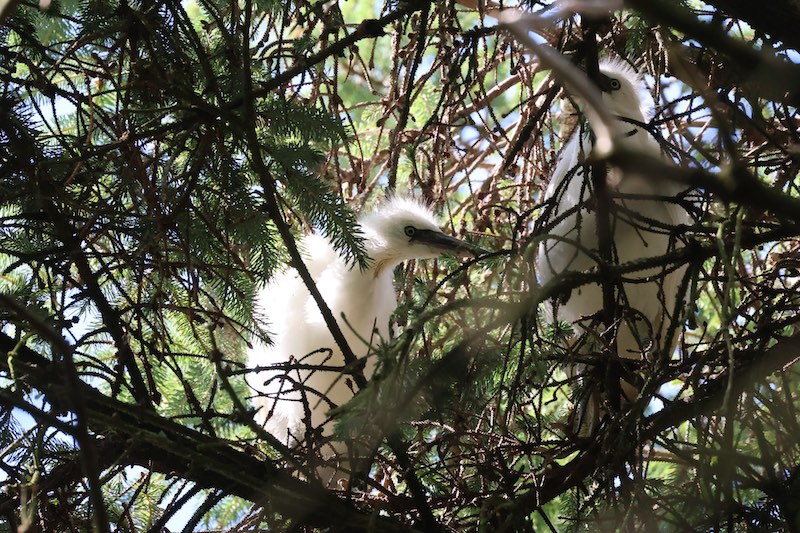
Little egrets have successfully bred in north east Scotland for the first time, with four chicks fledging at Forvie National Nature Reserve this summer.
The remarkable arrival is thought to be the most northerly breeding record for the species anywhere in the UK and provides another sign of how a changing climate is reshaping Scotland’s wildlife.
Little egrets were once predominantly Mediterranean birds, but their range has steadily moved north as higher temperatures and milder winters have made new areas suitable for them.
They were first recorded breeding in the UK in 1996, while Scotland had to wait until 2020 for its first confirmed breeding record in Dumfries and Galloway.
There are now thought to be around 1,500 to 2,000 breeding pairs across the UK, although Scotland’s population remains small.
Staff at Forvie were accustomed to seeing the elegant white birds fishing around the Ythan estuary, but there had been no indication they were actually raising young on the reserve.
That changed when a local birdwatcher spotted egrets in a tree within Forvie’s heronry.
NatureScot’s Forvie NNR manager Catriona Reid said:
“For years now, we have seen little egrets pretty regularly on the reserve, fishing in the Ythan estuary, but we didn’t think they were breeding.
“That was until a local birder told us they had spotted egrets up a tree in the reserve’s heronry.
“Egrets often nest with herons, so we started to keep an eye on them and watched as a rudimentary nest was built.
“However, this was two months after egrets are said to usually breed, proving yet again that wildlife does not follow the rules!
“To our great surprise, almost before we knew it, there were four well-grown youngsters scrambling around the trees.
“We’ve thoroughly enjoyed watching them clamber about and hearing their bizarre gargling noises.
“Only one pair have bred this year, but a second pair have been hanging around, and we’ve also had a regional high count of 17 including the youngsters.
“While it has been wonderful to have them here, the sobering fact is that this is one small part of a much wider story where the ranges of birds and other species are moving as a result of our warming climate.
“While that will provide opportunities for some species like the little egret, others, such as the mountain-breeding dotterel will be vulnerable and at risk.
“It underlines the urgent need for us to step up action to tackle the twin crises of nature loss and climate change.”
The expansion of little egrets has also been helped over the longer term by the decline of persecution, after the birds were extensively hunted during the 19th century for the delicate breeding plumes used to decorate fashionable hats.
Forvie’s four fledglings are therefore part of a much bigger story about a species returning, expanding and adapting.
Their appearance in the north east may be a wonderful sight, but the reason birds such as these are moving steadily north tells a rather more complicated story about the changing natural world around us.
Find out more about Forvie National Nature Reserve


