

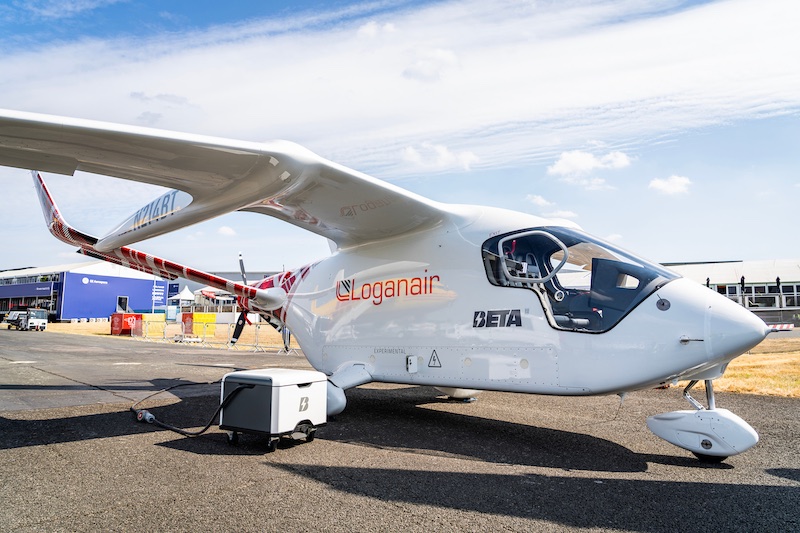
For generations Loganair has connected some of Scotland’s most remote communities by air, and now the airline is preparing for what could become the biggest change in its history after announcing plans to introduce all electric aircraft into commercial service from 2029.
The Scottish airline has signed an agreement with American manufacturer BETA Technologies to purchase five ALIA CX300 electric aircraft, with the option to acquire a further five, in a move that would make Loganair the first commercial airline in Europe to operate an electric aircraft fleet.
The announcement follows a successful series of demonstration flights earlier this year, when one of BETA’s electric aircraft completed 23 flights in ten days across Loganair’s Scottish network, operating between Glasgow, Dundee, Aberdeen, Inverness, Wick and Kirkwall.
During the trials the aircraft flew more than 1,000 nautical miles in real operating conditions, allowing engineers and airline staff to test everything from charging and ground handling to how the aircraft could integrate into existing airport operations.
The agreement represents a significant step towards bringing electric aviation into everyday passenger service, particularly in Scotland where many regional air routes are short enough to fall comfortably within the aircraft’s operating range.
Most of Loganair’s regional flights are less than 100 miles, making them well suited to the electric aircraft, which can recharge in as little as 20 to 40 minutes using high speed charging systems while producing zero in flight emissions.
The airline also believes the aircraft could reduce operating costs significantly while continuing to provide the reliable connections that many island and rural communities rely upon every day.
Luke Farajallah, Chief Executive of Loganair, said:
“This is a truly historic moment for Loganair and for European aviation.
“Our demonstration programme earlier this year proved that electric aviation is no longer a future concept, it is a viable commercial opportunity.
“The aircraft demonstrated the potential to reduce operating costs by up to 80% while maintaining the reliable regional connectivity our customers and communities depend on.
“Signing this agreement is the natural next step in that journey.
“It reflects our confidence in the technology, our partnership with BETA, and our ambition to remain at the forefront of sustainable regional aviation.
“We look forward to working together as we prepare to bring these aircraft into commercial service.”
The aircraft are expected to enter passenger and cargo service in 2029, with technical support and operational planning taking place over the coming years to ensure they can be integrated into Loganair’s existing fleet.
Kyle Clark, founder and Chief Executive of BETA Technologies, said:
“Loganair has spent six decades connecting communities that rely on air travel, so their standard for new technology is appropriately high.
“We met that standard the only way it can be met, by flying more than a thousand nautical miles across their network, on their routes, and in their conditions.
“This agreement is what happens when demonstrated performance meets an operator serious about the future of regional aviation.”
While the aircraft are still subject to certification before entering commercial service, the agreement signals a major vote of confidence in electric aviation and places Scotland at the forefront of what could become the next chapter in regional air travel.
If the programme delivers as expected, passengers travelling between Highland and island communities could be among the first in Europe to experience the benefits of regular electric powered commercial flights before the end of the decade.


