

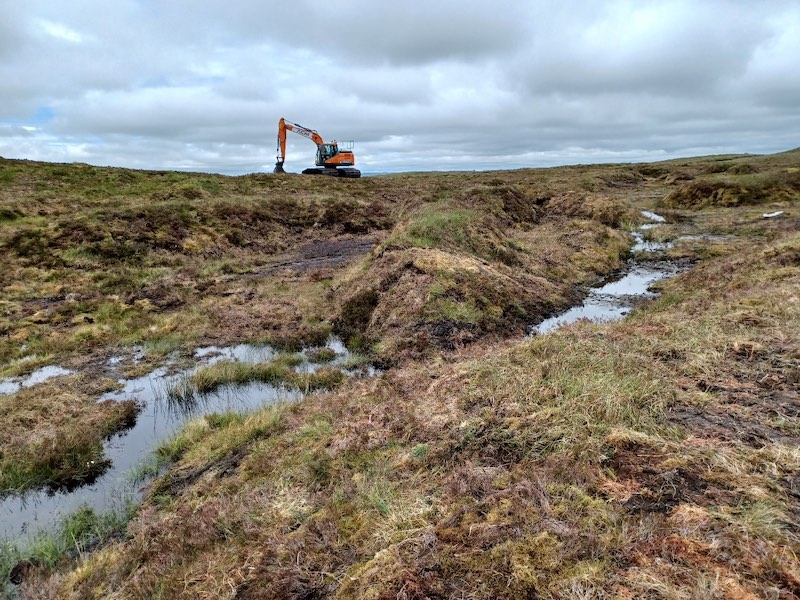
Protected golden eagles, winter storms, deep snow and live power lines were among the obstacles overcome by Forestry and Land Scotland teams as the organisation delivered a record year for peatland restoration across Scotland.
Forestry and Land Scotland restored 1,821 hectares of peatland during 2025 to 2026, surpassing last year’s total of 1,744 hectares and marking the organisation’s biggest peatland restoration effort to date.
The work took place across a wide range of locations including the Flow Country, Torrachilty, West Argyll, Lochaber, the Kilpatrick Hills, Flanders Moss, South Rannoch and Lochar Mosses.
More than 30 former commercial forestry sites were transformed through restoration work designed to return damaged peatland back to functioning bog habitat.
One of the most challenging projects took place at Ardintoul near Glenelg where a forest to bog restoration scheme became a race against weather, wildlife and time.
Before operations could begin, environmental surveys confirmed that a pair of golden eagles had shown interest in an old nesting site close to the proposed work area.
That immediately halted activity while Forestry and Land Scotland staff monitored the birds over several months to determine whether the nest would become active again.
Only after confirming the eagles had not occupied the nest were operations allowed to proceed.
Even then, a one kilometre exclusion zone had to be established around the nest site in case the birds returned during the following breeding season.
The situation became even more complicated due to live power lines running directly through the exclusion area, requiring sections of electricity infrastructure to be shut down before trees beneath the cables could safely be removed.
Storms during autumn followed by snow over the Christmas period delayed those shutdowns and placed increasing pressure on the project as the next eagle breeding season approached.
As conditions improved, additional machinery and operators were drafted in to accelerate harvesting, mulching, tree clearance and rewetting operations before the exclusion window closed again.
Power lines were eventually shut down with only a week remaining to remove the final standing trees beneath the cables.
Throughout the operation, Forestry and Land Scotland environmental staff continued monitoring for any return of the eagle pair while work inside the protected zone was completed.
FLS Peatland Restoration Forester Isabelle Destor said:
“The site at Ardintoul is a good example of the multiple challenges faced and decisions that are taken as part of our peatland restoration efforts.
“The wellbeing of habitats and protected species is at the forefront of planning and activity.
“Dealing with storms and snow along with live power lines also highlight the ability to be adaptable is an essential part of getting the job done.
“Achieving a record mark for restoration is all about collaborative working with our planners, environment teams, harvesting and civil engineering teams to enable peatland restoration to happen.
“Also essential to the successful delivery of the project is effective communication between FLS staff and contractors.
“It has been the efforts from the various teams and the use of specialist techniques and machinery that has allowed us to set more peatland on the road to recovery through ‘re wetting’ sites.”
Peatland restoration has become an increasingly important part of Scotland’s environmental strategy because healthy bogs absorb and store large amounts of carbon while damaged peatland releases emissions into the atmosphere.
Restoration also improves biodiversity, water quality and habitat resilience while supporting employment for specialist rural contractors working across remote parts of Scotland.
For Forestry and Land Scotland though, the latest figures also underline the growing complexity of environmental work where climate goals, wildlife protection, engineering and extreme weather increasingly collide on the ground.


