

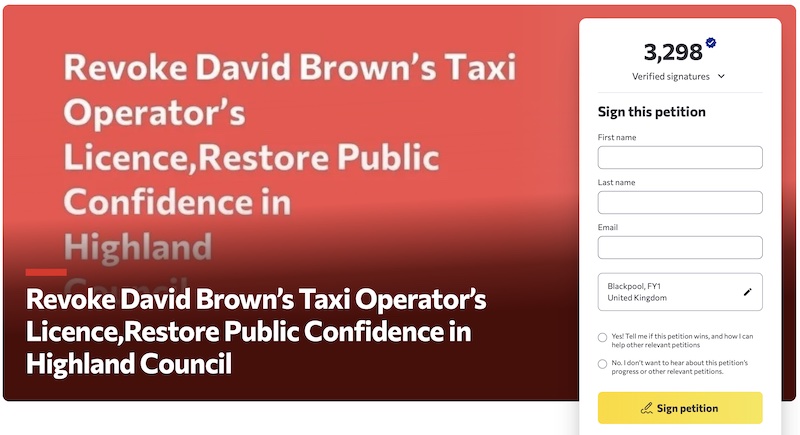
A growing public campaign calling for David Brown’s taxi operator’s licence to be revoked has brought renewed attention to the purpose of taxi licensing and the standards expected of those entrusted with carrying passengers.
The controversy surrounding the Highland Council Licensing Committee decision has prompted widespread debate across the Highlands, but for many campaigners the issue comes down to a simple and fundamental question.
Was Brown still a fit and proper person to hold a taxi operator’s licence after being convicted of rape and jailed?
For many people, the answer is clear.
Taxi licensing exists first and foremost to protect the public.
Passengers are entitled to expect that those holding licences connected with the taxi trade meet the highest standards of trustworthiness, integrity and public safety.
Brown was convicted of raping an 18 year old passenger he had picked up while working as a taxi driver and was sentenced to six years and nine months in prison.
He has also been placed indefinitely on the sex offenders register.
His taxi driver’s licence had already been suspended in January 2024, before his conviction, after councillors determined he was no longer a fit and proper person to continue driving a taxi.
However, following his conviction, Highland Council’s Licensing Committee voted not to revoke his separate taxi operator’s licence.
The distinction between a driver’s licence and an operator’s licence has featured heavily in discussions since the decision was taken.
An operator’s licence allows an individual to operate a taxi business and manage licensed vehicles, even if they are not personally driving them.
Campaigners argue that the distinction misses the central point.
The test is not whether someone is physically able to drive a taxi.
The test is whether they remain a fit and proper person to hold a licence connected to the industry at all.
Police Scotland objected to Brown retaining the operator’s licence and Highland Council has since referred the committee’s decision to a future meeting of the full council for reconsideration.
Public concern has continued to grow, with a petition calling for the licence to be revoked attracting thousands of signatures.
Supporters say confidence in the licensing system can only be maintained if public protection remains the overriding consideration in every decision.
The debate has also moved beyond the personalities involved.
The resignations of councillors from the Licensing Committee may have attracted headlines, but for many residents they are not the real issue.
The issue is whether the committee failed at the first hurdle.
If taxi licensing is designed to protect the public, then many believe the question should always have been straightforward.
Can a convicted rapist be considered a fit and proper person to hold a taxi operator’s licence?
That question will now sit at the heart of a decision which many people across the Highlands believe is about much more than one licence, but about confidence in the entire licensing system itself.


