

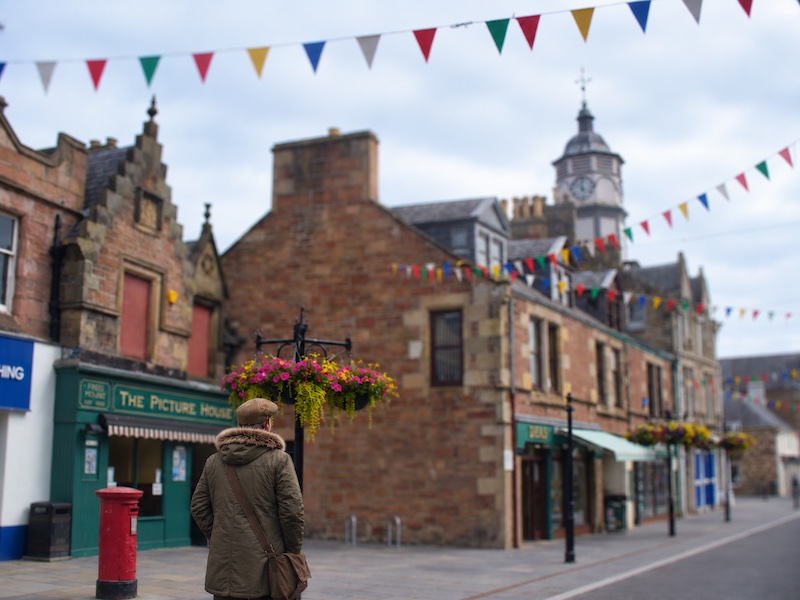
Last week I attempted to establish whether the Inverness Tourist Board actually existed and became unexpectedly involved in the considerably more difficult question of whether Dingwall existed either.
I concluded that I could neither confirm nor deny the existence of Dingwall.
Since then, matters have deteriorated.
An organisation calling itself the Dingwall Tourist Board has appeared.
This would ordinarily represent compelling evidence for Dingwall’s existence, were it not for the unfortunate fact that I have already been unable to establish whether tourist boards themselves can be trusted as evidence of anything.
The new organisation describes itself as celebrating the historic Burgh of Dingwall and the “not at all fictitious Dingwallians”, gives its address as The Cabbage Farm, Dingwall, and attracted more than 1,000 followers within days.
It is also gathering eyewitness testimony from people who claim to have seen Dingwall.
Places which have existed continuously for 800 years do not normally require eyewitnesses to prove it.
This is particularly troubling because Dingwall is currently celebrating 800 years since King Alexander II granted it Royal Burgh status in 1226.
There is substantial evidence that something calling itself Dingwall existed as recently as 7 August, when King Charles visited, met local organisations and unveiled a plaque commemorating the town’s 800th anniversary.
This initially appeared decisive.
However, the following day Vikings arrived.
They marched through the High Street before proceeding to Pefferside Park as part of what has officially been described as an historical reenactment.
The explanation is perfectly reasonable and I have found no evidence that the Vikings subsequently removed Dingwall by longboat.
Equally, nobody appears to have checked what they were carrying when they left.
There is another possibility.
Dingwall may be a pop up town.
King Charles apparently gained access, as have thousands of people who insist they live there, shop there or attend Ross County football matches, yet my own efforts to establish its permanent physical existence have proved considerably less satisfactory.
I have therefore provisionally classified people apparently capable of seeing and entering Dingwall as Guggies.
Whether Guggies are born with this ability, acquire it later in life or simply know which bus to catch remains under investigation.
There may even be a railway connection.
Dingwall railway station exists, or at least existed when the available photographs were taken, and has been allocated the station code DIN.
Trains can also be observed leaving.
What I have yet to establish satisfactorily is how they arrive.
This distinction matters.
A railway carrying people into a town would provide useful evidence of normal economic and social activity, while trains exclusively carrying people away from somewhere shortly after the arrival of Vikings may indicate something else entirely.
Immediately beside the station stands The Mallard, a public house which appears to provide a natural habitat for the Guggie.
The proximity may be significant.
In the Harry Potter books, passengers travelling to Hogwarts gain access to a railway platform concealed from ordinary people at King’s Cross, and while I am not suggesting Dingwall operates through precisely the same mechanism, the similarities warrant further investigation.
There is currently no evidence of an owl.
At this stage I returned to the Official Loch Ness Monster Sightings Register, which has become an increasingly important source of stability in my investigations.
The Register records 1,179 sightings of the Loch Ness Monster dating back to 565 AD, when St Columba reportedly encountered a water beast in the River Ness and ordered it to go back.
Nessie has been reported repeatedly since, suggesting either that St Columba’s instructions were insufficiently specific or the monster subsequently chose to ignore them.
This raises an obvious possibility.
Somebody may simply have told Dingwall to go back.
I have found no evidence that St Columba ever visited Dingwall, which means he cannot presently be considered a suspect.
Unfortunately, he died in 597, making further questioning difficult.
I have therefore contacted neither him nor the Official Loch Ness Monster Sightings Register for clarification.
The Register has enough on its plate.
For now, the emergence of the Dingwall Tourist Board has not resolved the original question.
It has merely provided another organisation claiming knowledge of a town whose permanent existence remains disputed by the Inverness Tourist Board, while simultaneously introducing Vikings, a railway from which trains apparently only leave and a growing population of Guggies into an investigation which was already considerably more complicated than anticipated.
My enquiries continue.
If anyone has photographic evidence of a train actually arriving in Dingwall, I would like to see it.
Photographs of trains already standing there will not be accepted.
They may simply have been left behind.
If you have any conspiracies you would like Aye to investigate, email conspiracycorner@thehighlandtimes.com


