

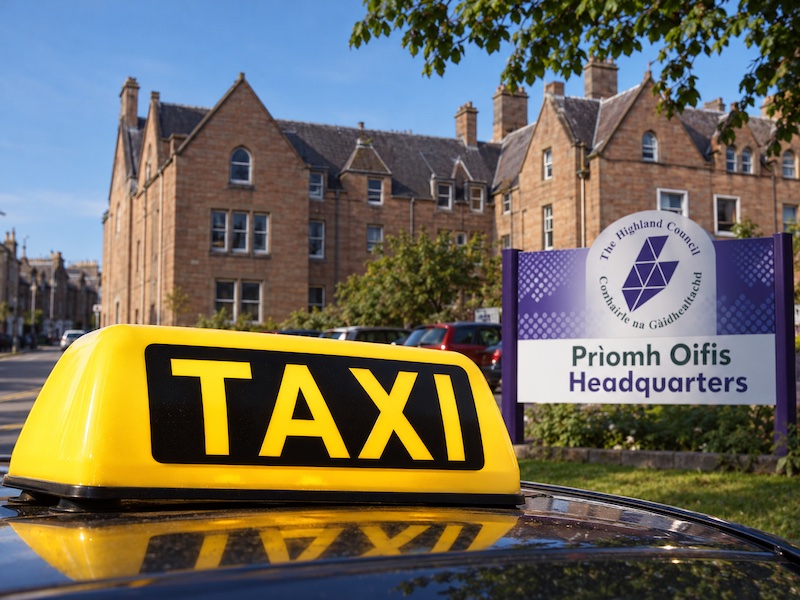
Six Highland councillors became the focus of public outrage after voting to retain taxi operator licences held by convicted rapist David Brown, but an uncomfortable question remains unanswered.
Were they actually wrong, or has Highland Council allowed its own responsibilities to become overshadowed by the condemnation of elected members?
Nobody should diminish the appalling crime committed against an 18 year old woman, or the seriousness of the decision that followed.
But there is an important distinction that appears to have been lost amid the anger.
Brown’s taxi driver’s licence had already been suspended in January 2024, more than two years before the controversial hearing on 23 June 2026.
The six councillors were considering his separate taxi operator licences, which did not authorise him personally to drive.
They also received professional advice from Highland Council officials, including legal guidance about the distinction between the two licences.
Councillor Chris Birt subsequently explained that members had been advised that an operator could employ licensed drivers without personally driving.
Brown was imprisoned, and some councillors argued that retaining the operator licences would allow his wife to support their family without placing him behind the wheel.
Four female councillors disagreed, as did Police Scotland, whose objections deserved serious consideration.
But was retaining the licences unlawful, or was it a judgement councillors were legally entitled to make?
The council’s senior legal officer subsequently challenged the decision on grounds involving possible illegality or maladministration, but Brown surrendered his licences before the full council could reconsider it.
No final ruling emerged from that process.
On 17 September, councillors voted by 56 votes to six to declare no confidence in five colleagues, with further proposals now seeking to remove them from certain council responsibilities.
And yet, perhaps the most striking aspect of this controversy is the relative silence of the politicians whose reputations are being damaged.
These are elected representatives whose political careers could be seriously affected, yet their public defence has been remarkably restrained.
During September’s council debate, Councillor Emma Knox confirmed that committee members had been advised not to discuss the case publicly.
The original hearing was private, and details subsequently emerged through what councillors described as a whistleblower leak.
Some members have explained their reasoning, but the full professional advice and confidential evidence remain unavailable to the public.
Were these politicians effectively placed in a position where they faced public condemnation but could not fully defend the decision they made?
Who advised them not to speak, how extensive was that advice, and does it remain in force?
And did the councillors voting no confidence have access to the same confidential evidence and legal guidance?
The controversy also extended to Councillor Duncan Macpherson when former Highland councillor Allan Duffy submitted a Freedom of Information request seeking to establish whether the council held records of complaints or allegations involving him.
Highland Council refused the request on 8 October, describing it as vexatious under freedom of information legislation, a decision Duffy has formally challenged.
The request itself establishes no wrongdoing by Macpherson, and there is no verified evidence that any such allegation was substantiated.
But its appearance during the wider controversy illustrates how far the political fallout has spread.
There is another uncomfortable issue for Highland Council.
In January 2024, its licensing committee suspended Brown’s driver’s licence without removing his separate operator licences.
That earlier distinction deserves examination alongside the professional advice given in June.
Public anger over the original decision is understandable, and elected representatives must answer for their judgement.
But political condemnation is not a legal finding of wrongdoing, and advice restricting public discussion raises important questions when reputations are at stake.
The councillors must account for their decision, but Highland Council must also explain its advice, procedures and whether its approach to confidentiality has hindered their ability to defend themselves.
Until those questions are answered, the public cannot fully judge where responsibility for this affair lies.


