

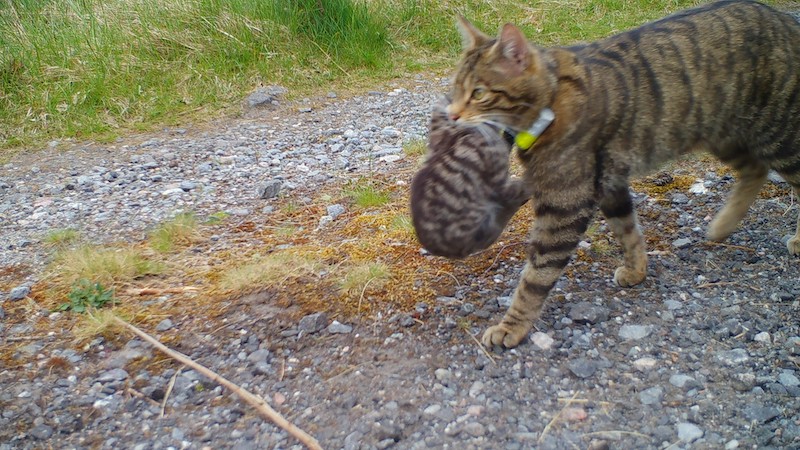
Several released female wildcats have given birth to new litters in the Cairngorms National Park this June, marking a third consecutive year of wild births for the Saving Wildcats project.
The milestone was announced by wildlife conservation charity the Royal Zoolical Society of Scotland, which leads the project aimed at restoring Scotland’s critically endangered wildcat population.
The latest births follow successful breeding seasons in both 2024 and 2025 and represent another important step in efforts to prevent the species disappearing from the Scottish landscape.
Project staff first suspected kittens had been born after observing changes in behaviour from several female wildcats fitted with GPS radio collars.
Monitoring data showed some females repeatedly returning to the same locations, a recognised sign that kittens may be present.
The breakthrough came on 2 June when trail cameras captured footage of a released female carrying kittens along a path.
Female wildcats commonly move their young between den sites to improve safety and shelter.
Louise Hughes, Saving Wildcats field operations manager, said:
“There is so much anticipation when you first suspect there have been kitten births.
“It is a truly exciting event and seeing kittens on trail cameras really lifts the whole team and spreads a genuine buzz throughout the many communities across Scotland that support wildcat restoration.”
Project staff are continuing to monitor other females and say it is too early to know exactly how many litters have been born or how many kittens are now in the wild.
The team is using GPS collar data and trail cameras to gather further evidence while minimising disturbance to the animals.
Conservationists say the births are one of the clearest signs yet that released wildcats are adapting successfully to life in the wild.
Roo Campbell, NatureScot Mammal Specialist said:
“This increase in the wild population is one of the most encouraging signs a reintroduction project can have.
“It shows that the wildcats that have been released are adapting to the wild, surviving, finding mates and reproducing without human support.”
Despite the positive news, experts caution that Scotland’s wildcat population remains small and vulnerable.
Additional releases are planned this summer to strengthen genetic diversity and help the population withstand future threats including disease, severe weather and wildfires.
Since 2023, the project has released 46 wildcats into the Cairngorms National Park as part of a long term effort to restore a sustainable wild population.
Saving Wildcats is also reminding members of the public that wildcats are protected by law and should never be deliberately approached or disturbed.
Anyone who believes they have seen a wildcat in Badenoch and Strathspey is encouraged to report the sighting to the project team to help support ongoing monitoring and conservation work.
For those working to save one of Scotland’s most iconic native species, the arrival of a new generation of wild born kittens is another welcome sign that the fight against extinction is beginning to bear fruit.
Suspected sightings of wildcats in the project area of Badenoch and Strathspey are welcomed and can be reported to wildcats@rzss.org.uk


