

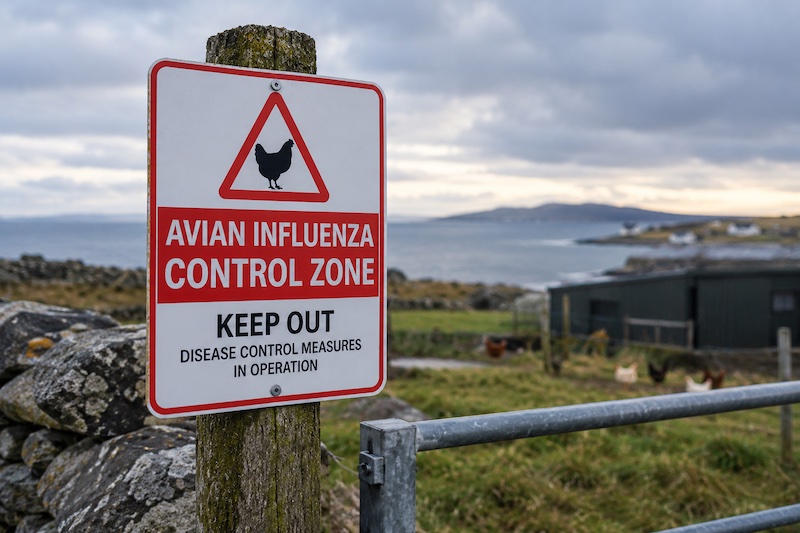
An outbreak of highly pathogenic avian influenza has been confirmed in Ness on the Isle of Lewis, with protection and surveillance zones now established around the affected area.
The outbreak was confirmed on 2 October, prompting the Scottish Government to establish a three kilometre Protection Zone and a wider 10 kilometre Surveillance Zone as measures are taken to control the spread of the disease.
Comhairle nan Eilean Siar and NHS Western Isles are urging residents to follow official guidance, particularly anyone keeping poultry or captive birds within the affected area.
The Animal and Plant Health Agency is leading the response, supported locally by Comhairle animal health staff and the Scottish Government’s Rural Payments and Inspections Directorate.
Road signs are being erected to identify the control zones, while people living within the three kilometre Protection Zone will receive letters explaining the measures in greater detail.
A Comhairle spokesperson said:
“Our Animal Health staff will be putting up road signage highlighting the zones and anyone who has livestock within the general area of outlined in the map area should read the detail of the declaration and check if they are in the 3km Protection Zone or 10km Surveillance Zone and follow the measures mentioned.
“If you live in the 3 km protection zone, you will receive a letter explaining in more detail what is happening in your area to control spread of disease.
“All keepers of poultry or captive birds in the 3 km protection zone will be visited by an APHA veterinarian in the next weeks.
“These veterinary visits are carried out to ensure that your birds are healthy and to help you to protect them from disease”
Anyone keeping chickens, turkeys, ducks, geese, pigeons, birds of prey or other poultry and captive birds within either control zone is being asked to ensure their details are registered and up to date on the Scottish Kept Bird Register.
Public health officials have stressed that the risk to the general public remains very low, while the risk to people who have had close and prolonged contact with infected birds is also considered low.
Poultry products, including eggs, remain safe to eat when properly handled and cooked.
People are also being asked to continue reporting dead wild birds and to avoid unnecessary contact with sick or dead birds as surveillance continues.
Symptoms associated with avian influenza can include red or watery eyes, coughing, a sore throat, a blocked or runny nose, shortness of breath, fever, muscle aches, tiredness, headaches, chills, diarrhoea, nausea or vomiting.
Anyone developing symptoms after contact with birds or a potentially contaminated environment should seek medical advice and tell healthcare staff about the possible exposure before attending in person.
For residents in Ness and the surrounding area, the immediate message is to follow the restrictions, keep bird registrations up to date and allow the agencies dealing with the outbreak to contain the disease while the risk to human health remains very low.


