

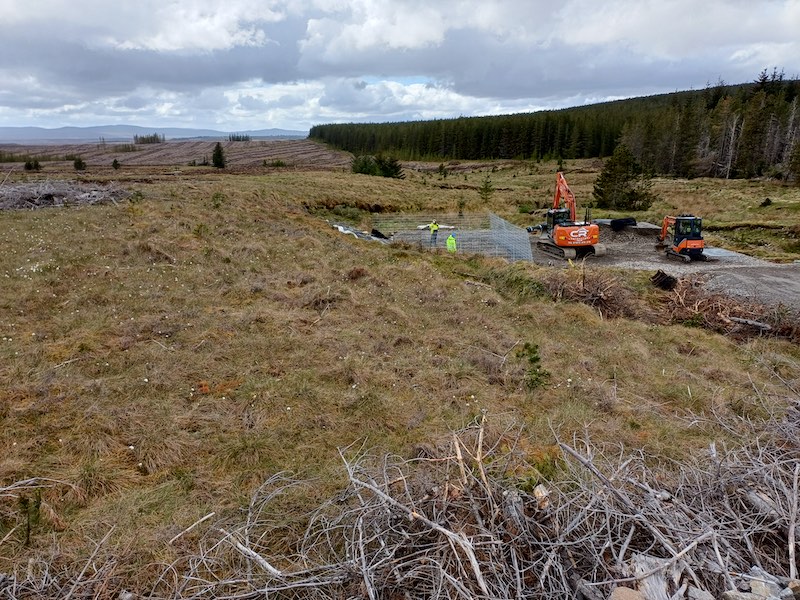
Hidden behind many of Scotland’s forestry operations is a network of roads, bridges and infrastructure that few people ever see but without which much of the work simply could not happen.
Across the north of Scotland, Forestry and Land Scotland’s civil engineering team has spent the past year building, repairing and maintaining the infrastructure that supports timber harvesting, peatland restoration, visitor facilities and forest access.
Among the most challenging projects were the construction of a bridge and specialist “floating” road across remote peatland at Dalchork, where engineers had to create access routes on ground with almost no natural load bearing capacity.
The work is part of a much wider programme that saw the North Region team deliver more than 150 projects during 2025 and 2026.
That included almost six kilometres of new roads, 66 kilometres of road upgrades, 163 kilometres of maintenance work, six new bridges, 12 bridge maintenance projects and the replacement of 100 culverts.
The improvements helped forestry teams access 61 harvesting sites while also delivering upgrades at visitor destinations, including the major car park improvements at Glenmore.
North Region Area Civil Engineer Liam Matheson said:
“A lot of what the civils team does is unseen or in the background.
“The projects need a lot of detailed planning from concept through to delivery with many jobs requiring some level of permissions, prior notifications and authorisations from regulators such as SEPA, Scottish Forestry and NatureScot and power companies.
“There are often a range of challenges that our engineers contend with that arise from terrain and topography.
“Engineers must work with the landscape to integrate structures like roads and bridges with the natural environment.
“This ensures projects are safe, sustainable, and adapted to any ecological constraints.”
The team also manages infrastructure in some of the Highlands’ most challenging landscapes, including steep slopes above Loch Ness and along the shores of Loch Carron, where heavy rainfall and severe weather can threaten roads, bridges and drainage systems.
Maintaining access is vital not only for forestry operations but also for environmental projects such as peatland restoration, which often require specialist engineering solutions.
Mr Matheson said:
“Working on peatland is one of the most testing when preparing access for harvesting teams to remove timber ahead of forest to bog restoration work.
“Building roads and bridges or crossings on peat is technically difficult because the ground has no load bearing capacity.
“Roads need to be ‘floating’ on top to minimise any impact on the hydrology of the area.”
The scale of the task facing the engineering team is considerable.
Across the north of Scotland alone, Forestry and Land Scotland manages more than 1,500 kilometres of roads, almost 400 bridges and countless culverts, drains and quarries.
Mr Matheson added:
“If we were to replace all the infrastructure and resources, it would cost in the hundreds of millions and take decades.
“So, while it is a challenge staying on top of it all, engineering it is a vital part of FLS operations.”
While much of the work takes place out of sight, it continues to provide the foundations for sustainable forestry, environmental restoration and public access across some of Scotland’s most spectacular landscapes.


