

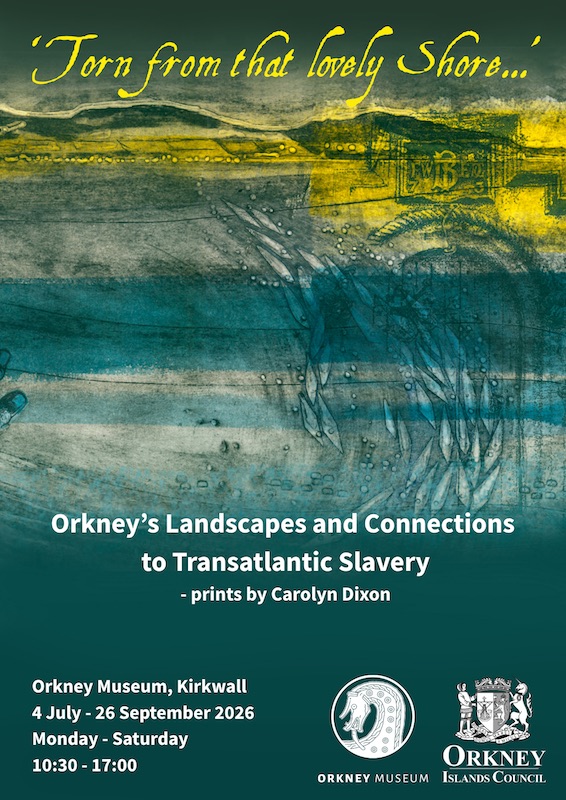
A new exhibition opening at Orkney Museum this summer will explore a difficult and often overlooked chapter in the islands’ history by examining Orkney’s connections to transatlantic slavery.
Torn from that lovely shore… opens on Saturday 4 July and runs until 26 September in the museum’s recently transformed exhibition space.
Created by Orkney based artist Carolyn Dixon, the exhibition combines printmaking, artists’ books and historical research to investigate the lives of Orcadians who travelled to the Caribbean and the Americas during the seventeenth, eighteenth and early nineteenth centuries.
Drawing on material held by institutions including the National Records of Scotland, the National Archives at Kew, the National Library of Scotland and historical societies in the United States, the exhibition represents several years of research and development.
Through artwork and accompanying interpretation, the exhibition tells the stories of Orcadians whose lives intersected with slavery and the slave trade, many of whom came from merchant, maritime and religious backgrounds.
The exhibition also examines records showing that slavery itself was not entirely absent from Orkney, presenting evidence that enslaved and formerly enslaved people were present in Kirkwall and Stromness during the eighteenth century.
Historical documents and archive material featured within the exhibition include references to the violence experienced by enslaved people and visitors are advised that some content may be distressing.
Artist Carolyn Dixon said she hopes people will leave with a deeper understanding of the stories that lie behind the work.
“There’s a saying that every picture tells a story, and that’s what I hope visitors will take from this exhibition.
“The title ‘Torn from that lovely shore’ is deliberately ambiguous.
“For many of us today, Orkney is ‘that lovely shore’.
“But when Burns wrote those words in his 1792 poem ‘The Slave’s Lament’, that shore was ‘sweet Senegal’ and the person torn from it was one of the 3.5 million Africans abducted and enslaved by Britain in the 275 years of British Transatlantic slavery.”
Orkney Museum Social History Curator Ellen Pesci said museums have a responsibility to present history in all its complexity.
“History doesn’t always sit comfortably, and this is one of those times it shouldn’t.
“Part of our job as a museum is to present this material honestly and in its proper context, rather than only telling the parts of our past that are easier to tell.
“We hope this exhibition gives people a space to look closely at this history, ask questions, and talk about what it means for how we understand Orkney today.”
The exhibition forms part of a wider movement among museums and heritage organisations to examine difficult aspects of local and national history and provide opportunities for communities to engage with the legacies that continue to shape society.
Orkney Museum is open Monday to Saturday from 10.30am until 5pm and traces the story of the islands over more than 6,000 years.


