

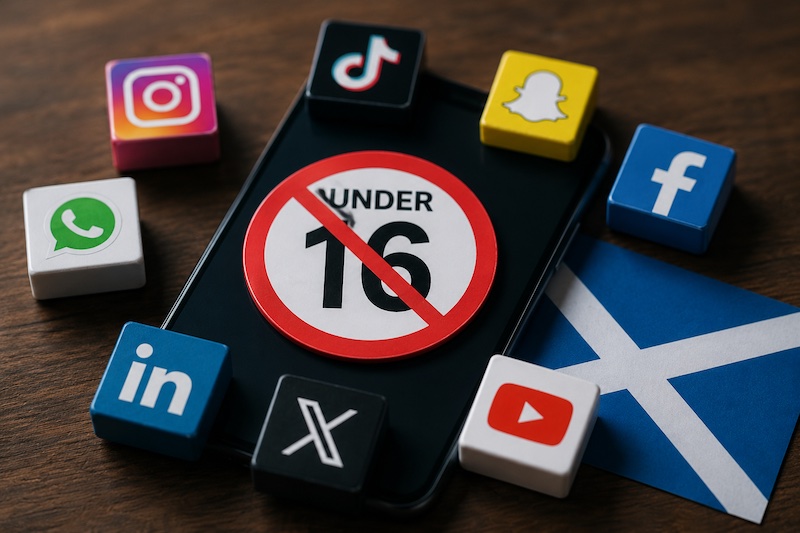
The UK Government’s plan to ban under 16s from social media has sparked a fierce debate, with children’s organisations and politicians agreeing that young people need greater protection online but differing on whether a ban is the right answer.
Prime Minister Sir Keir Starmer announced plans to restrict social media access for under 16s as part of a wider effort to tackle online harms, including stranger contact, harmful content and excessive screen use.
The proposal has been welcomed by some campaigners as a sign that governments are finally taking the impact of digital platforms on children seriously.
However, others have warned that banning young people from social media could create new risks while failing to address the behaviour of the technology companies that run the platforms.
Scotland’s Children and Young People’s Commissioner, Nicola Killean, said she was disappointed by the announcement and argued that children themselves had been largely left out of the conversation.
“We are disappointed that the UK Government has announced today its intention to ban children under the age of 16 from social media.
“The available evidence does not currently show a blanket ban would make children safer online, and it may inadvertently push children to less regulated or riskier parts of the internet.”
She also warned that platforms should not be allowed to avoid responsibility for making their services safer.
“Platforms must be made to take more accountability in preventing harm, addictive and exploitative features should be the focus.
“Platforms should change so they are suitable for children, rather than children simply being banned from them.”
Children’s charity Children First broadly welcomed the direction of travel, describing it as recognition of what it called a national childhood emergency.
Chief Executive Mary Glasgow said:
“The UK Government’s move to restrict social media for under 16s and tackle live streaming and stranger contact is a welcome indication of the desire to protect children in the face of a national childhood emergency.”
However, she also argued that restrictions alone would not solve the deeper problems built into many online platforms.
“Given children are likely to find ways around a ban, they will continue to be harmed unless tech companies are forced to implement changes to ensure their products are safe from the start.”
The Scottish Greens have also criticised the proposal, arguing that it targets access rather than the systems that drive harmful content.
Laura Moodie said:
“Protecting children should be paramount, but you can’t child-lock the internet and pretend the job is done.”
“The danger is not that young people have social media accounts, it is that platforms are flooded with harmful content, misinformation and algorithms designed to maximise engagement at any cost.”
Across the debate, one theme has emerged consistently.
Whether they support the ban or oppose it, campaigners, children’s organisations and politicians all agree that technology companies must take greater responsibility for the products they create and the content they promote.
The challenge now facing ministers is whether a ban alone can achieve that goal, or whether more fundamental changes to how social media platforms operate will ultimately be required.


