

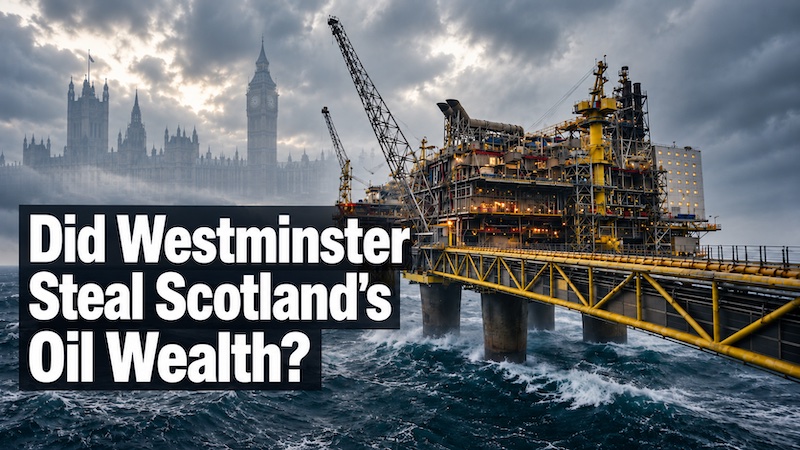
The approval of the Jackdaw gas field has reopened one of the most uncomfortable questions in British economic history, what happened to Scotland’s oil and gas fortune?
On Wednesday 21 October, the UK Government approved production at the North Sea field, around 150 miles east of Aberdeen, while announcing a new £2 billion Energy Wealth Fund.
But the announcement carried an extraordinary admission from Chancellor John Healey, who acknowledged that Britain could have accumulated a sovereign wealth fund worth around £1 trillion had North Sea revenues been invested over previous decades.
A trillion pounds represents an astonishing potential inheritance, raising difficult questions about how successive governments managed one of Britain’s greatest natural resources.
For more than fifty years, Scotland’s offshore oil and gas industry has generated enormous wealth, supporting employment, investment and tax revenues flowing directly into the UK Treasury.
Those revenues were absorbed into Britain’s wider public finances, helping support government expenditure and investment across the country rather than being preserved in a dedicated fund for future generations.
The money did not simply disappear, but the decisions about how it was spent were largely made at Westminster.
Major infrastructure projects, public services and national events were financed from the same wider public finances into which North Sea revenues flowed.
The London Olympics in 2012, for example, received a public sector funding package of approximately £9.3 billion, including substantial central government support.
There is no evidence that particular North Sea tax receipts were allocated directly to the Olympics, but those revenues contributed to the national finances that supported such expenditure.
It is a distinction worth making because the real question is not whether Scotland’s wealth was spent, but whether enough of it was invested for Scotland’s long term benefit.
Norway took a different approach, investing petroleum revenues in a sovereign wealth fund that has become one of the largest investment funds in the world.
Britain chose not to establish an equivalent fund during the decades when North Sea production was generating substantial tax receipts.
The potential economic significance of Scotland’s resources had been recognised as early as 1974, when government economist Gavin McCrone prepared a confidential report examining the financial implications of Scottish independence.
McCrone concluded that North Sea oil could transform Scotland’s economic position, potentially creating substantial budget surpluses if sufficient revenues accrued to an independent Scottish government.
His report remained outside public view for decades, but the opportunities it identified became central to arguments about Scotland’s economic future.
During the 2014 independence referendum, declining North Sea production, uncertain revenues and the costs of recovering remaining resources were repeatedly highlighted as significant financial risks.
Yet the UK Government’s own estimates that year identified between 11.1 billion and 21 billion barrels of oil equivalent in remaining reserves and resources, although not all were necessarily commercially recoverable.
The North Sea is undoubtedly a mature basin, and production has declined substantially, but Jackdaw demonstrates that economically valuable resources remain.
The new field is expected to increase domestic gas production by around six per cent at its peak, contribute approximately £2.9 billion to the UK economy and operate for up to eleven years.
Environmental campaigners oppose the development, arguing that continued fossil fuel extraction threatens climate commitments without guaranteeing cheaper energy bills.
Those concerns are significant, but they do not remove the question of how Britain should manage the revenues generated by its remaining offshore resources.
Figures published by HM Revenue and Customs show that oil and gas production generated another £4.3 billion in UK tax revenues during the financial year ending April 2026.
First Minister John Swinney has questioned why the government’s initial £2 billion investment fund represents only around half that figure and has called for revenues to support renewable energy opportunities in northeast Scotland.
He also wants greater Scottish control over decisions affecting offshore energy, arguing that communities which helped create the industry’s wealth should benefit from its remaining economic opportunities.
The Chancellor’s hypothetical £1 trillion British fund cannot automatically be treated as the amount an independent Scotland would have accumulated, because that calculation would require different assumptions about revenue, government spending and investment returns.
Nevertheless, the central historical decision is clear.
Successive British governments used North Sea oil and gas revenues to support public expenditure rather than systematically invest a substantial proportion in a sovereign wealth fund.
Now, more than half a century after offshore energy transformed Scotland’s economy, Westminster is proposing to create the kind of lasting investment vehicle that might have been established decades earlier.
Jackdaw may be the latest chapter in the North Sea’s story, but it has brought an older question back into sharp focus.
After decades of oil and gas revenues flowing into the UK Treasury, what lasting financial inheritance has been created, and what might Scotland’s future have looked like had more of that wealth been saved?


